Category Archives: Archives

Why I like local newspapers

A while ago I wrote a blog post about Lucy Silversides (1840-1887), born Lucy Rhodes, an ancestor of mine who died within two weeks of her admission to Broadgate Hospital, the East Riding County pauper lunatic asylum in Walkington near Beverley. I found information about Lucy’s stay in the hospital’s case book number 5 held by the East Riding archives. Lucy had been admitted from the Selby Union on 1 March 1887. It is known that in 1881 she was living with her husband John, a labourer, and six children in Dam End, Riccall, Yorkshire

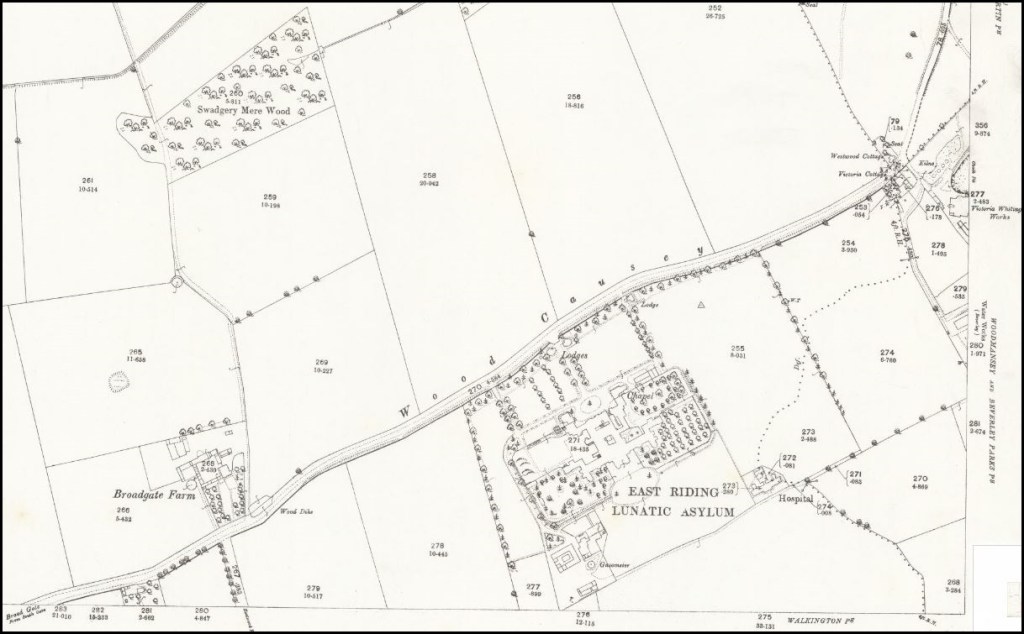
Broadgate opened on 25 October 1871 on part of Broadgate farm and was demolished in 1989. The following OS Yorkshire CCX.II map, dated 1893, shows the location of the asylum to the north east of the village of Walkington, just off the B1230 road.
The hospital case book mentioned that Lucy’s first mental health attack had lasted for eight months, although it did not say where she was when this occurred. Perhaps she had spent some time in the workhouse in Selby before being admitted to Broadgate? The book went onto describe Lucy as being aged 50, married and that she was Church of England. Lucy’s physical condition was described as tall, poorly nourished and dirty. With regards to her mental health, she was of a nervous temperament, dangerous and with her form of insanity described as mania. She was said to be excited and that “the patient talks to herself”. The case book explained that on 4 March “her conversation was silly and voluble”. By 11 March Lucy was “physically in a very bad state and appears to be getting weaker daily…she is nervous and excited and most difficult to manage in short nothing can be done with her…she won’t eat.” It went onto say that “the diet for the most part consists of butter, eggs milk mixture with brandy”. Lucy had diarrhoea. She died on 13 March 1887 at 8.50pm in the presence of nurse Phebe Allan. Her cause of death was Phthisis, now more commonly known as pulmonary tuberculosis. An autopsy was conducted and the record certified by the asylum Medical Superintendent Dr Murdoch Donald Macleod. After her death Lucy was buried in St Mary’s churchyard, Riccall.

When Lucy died in 1887, the medical superintendent of the asylum was Dr Murdoch Donald Macleod. Deaths in County Pauper lunatic asylums were reported in the asylum annual reports and the reports themselves often covered in local newspapers. At the moment the East Riding archives are closed to visitors so I wondered if the local newspapers had information relating to the asylum in 1887. A summary of 16th annual report for the asylum (for the year 1887) was published in the Beverley Recorder on 4 February 1888. Dr Macleod reported that “during the year 56 patients were admitted, and 51 discharged, while 13 men and 16 women died”. Lucy was one of those women. Dr Macleod held the view that those patients “admitted from this district usually suffer from varieties of insanity which as a rule do not present hopeful prospects of care”. He was reported as saying that:

“In many of the more isolated villages of the Riding there appears to be a considerable amount of hereditary tendency, not so much to actual insanity as to an ill-balanced ill-developed nervous system, producing individuals who are never very bright, and who, when subject to the strain of some exciting cause, develop habits and tendencies which necessitate them being placed under care.”

In Lucy’s case she came from a more populous village and the agricultural depression mentioned later in the report by Dr Macleod was more likely to have been a contributing factor to her physical and mental health than a lack of intelligence. Lucy and her husband John (1822-1888) came from different villages in the Riding.

Turning next to a project I am involved with, the FACHRS (Family and Community Research Society) asylums project, I have been looking at local newspaper reports and found them a useful source particularly when tracing the changes in medical superintendents during the project study period 1861-1901.

Broadgate hospital was built to serve patients from the East Riding of Yorkshire when the North and East Ridings asylum in Clifton, York became over crowded. It opened in 1871 and closed in 1989. In its first 10 years of operation it had the following three medical superintendents:

  • Dr Niel Grey Mercer (1841-1877) – Dr Mercer was a Scot who had trained in Edinburgh where he gained MD and LM qualifications. With his appointment in 1871 he was the first medical superintendent for Broadgate. He had previously been the Senior Assistant Medical Officer at the Lancaster County asylum. A report of his sudden death from illness on 1 January 1877, at the age of 36, was reported in the Beverley Guardian of 6 January 1877.
  • Dr Richard Greene (1844-1927) – Dr Greene was born in the USA and trained in Edinburgh where he gained LRCP, LM and LRCS qualifications and LSA in London. The Hull Packet of 19 July 1878 reported that he had been offered a more lucrative appointment in Northampton. He may have “poached” some of his staff as some were recorded as moving to Northampton in 27 August 1878 edition of the Yorkshire Post. Dr Greene continued to practise at Northampton for the remainder of his career. He was awarded a pension according to the Northampton Mercury of 25 February 1898.
  • Dr Edmund Bancks Whitcombe (1843-1911) – Dr Whitcombe was born in Shropshire and gained his LSA in Birmingham and his MRCS in England. The Hull News of 24 August 1878 reported that he had just started work at Broadgate hospital. Dr Whitcombe’s move to the Birmingham City asylum was reported in the York Herald of 3 January 1882 together with details of his successor Dr Macleod. In 1881, while in Birmingham, Dr Whitcombe advocated changes to the system of care for lunatics and proposed the need to trial a separate hospital system (Birmingham Mail 15 March 1888). He died in post in Birmingham in 1911.

So, it seems that two out of the first three medical superintendents at Broadgate went onto having careers lasting more than 20 years in the asylums they moved to. Perhaps they saw Broadgate as an interim appointment until they found where they wanted to be.

The fourth medical superintendent at Broadgate, Dr Murdoch Donald Macleod, was a Scot born in 1852. He gained his MB and LRCS in Edinburgh. Before his appointment he had been the Assistant Medical Officer at the Cumberland and Westmorland asylum. While at Broadgate he involved himself with the local community; on one occasion he arranged a series of first aid classes for the ladies of Beverley (Beverley and East Riding Recorder 7 May 1887). According to his obituary in the Beverley Independent (7 March 1908) Dr Macleod retired due to ill-health on 30 June 1906 and had subsequently become a physical wreck. He left a widow, three sons and two daughters.

A series of local newspapers proved invaluable in tracing the changes of medical superintendents at Broadgate hospital. I will leave you with one final thought. With the demise of local newspapers in many parts of the country will future family historians be able to carry out this kind of detective work.

Note: the map used in this blog has been reproduced with the permission of the National Library of Scotland under the following creative commons license https://creativecommons.org/licenses/by-nc-sa/4.0/ and sourced from the NLS maps site https://maps.nls.uk/.

Abbreviations:

LM – Licentiate in Midwifery

LRCP – Licentiate of the Royal College of Physicians

LRCS – Licentiate of the Royal College of Surgeons

LSA – Licentiate of the Society of Apothecaries

MB – Bachelor of Medicine

MD – Doctor of Medicine

MRCS – Membership of the Royal College of Surgeons

Bibliography:

Beverley & East Riding Recorder. https://www.findmypast.co.uk/ : accessed December 2023.

Beverley Guardian. https://www.findmypast.co.uk/ : accessed December 2023.

Beverley Independent. https://www.findmypast.co.uk/ : accessed December 2023.

Birmingham Mail. https://www.findmypast.co.uk/ : accessed December 2023.

Births, marriages and deaths. https://www.ancestry.co.uk/ : accessed December 2023.

Broadgate asylum. https://www.countyasylums.co.uk/broadgate-beverly/ : accessed December 2023.

Broadgate hospital case books. NH/6/64/20, pp 131-132.

Census records. https://www.ancestry.co.uk/ : accessed December 2023.

Hull News. https://www.findmypast.co.uk/ : accessed December 2023.

Hull Packet. https://www.findmypast.co.uk/ : accessed December 2023.

Northampton Mercury. https://www.findmypast.co.uk/ : accessed December 2023.

OS Map. https://maps.nls.uk/ : accessed December 2023.

Probate records. https://www.ancestry.co.uk/ : accessed December 2023.

Riccall. https://www.genuki.org.uk/big/eng/YKS/ERY/Riccall : accessed December 2023.

UK & Ireland, Medical Directories, 1845-1942. https://www.ancestry.co.uk/ : accessed December 2023.

UK & Ireland, Medical Registers, 1859-1943. https://www.ancestry.co.uk/ : accessed December 2023.

West Yorkshire, England Police Records, 1833-1914. https://www.ancestry.co.uk/ : accessed December 2023.

Yorkshire baptisms, marriages and burials. https://www.findmypast.co.uk/ : accessed December 2023.

Yorkshire Post. https://www.findmypast.co.uk/ : accessed December 2023.
Lucy Silversides (1840-1887)

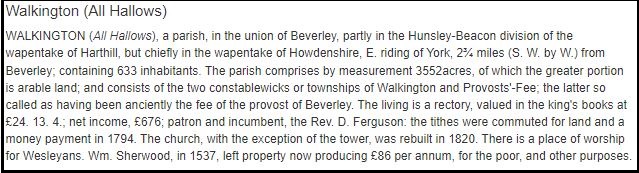
Whilst visiting the East Riding archives at Beverley, I carried out a search of the East Riding of Yorkshire County pauper lunatic asylum case books (NH6/64/20) to see if there were any records for any of my ancestors who might have been admitted to it. The asylum was called Broadgate Hospital and located in Walkington near Beverley. The land it was built on was part of Broadgate farm; it was opened on 25 October 1871 and has since been demolished. Walkington was described by Lewis in 1848 as follows:

The following OS Yorkshire CCX.II map, dated 1893, shows the location of the asylum to the north east of the village of Walkington, just off the B1230 road.

The East Riding archives hold a series of case books for Broadgate hospital and my ancestor Lucy Silversides featured in the women’s case book number 5. Lucy was the wife of John Silversides (1822-1888), my second cousin five times removed. She was born Lucy Rhodes in 1840 in Patrington, Yorkshire to parents Thomas Rhodes (1804-1883) and Elizabeth Blenkin (1805-1879). By the time Lucy’s brother Arthur died in 1854, the family were living in Osgodby, a few miles from Riccall where John Silversides lived. Lucy married John in St Mary’s church, Riccall on 11 November 1858; Lucy was 18 and John 36.

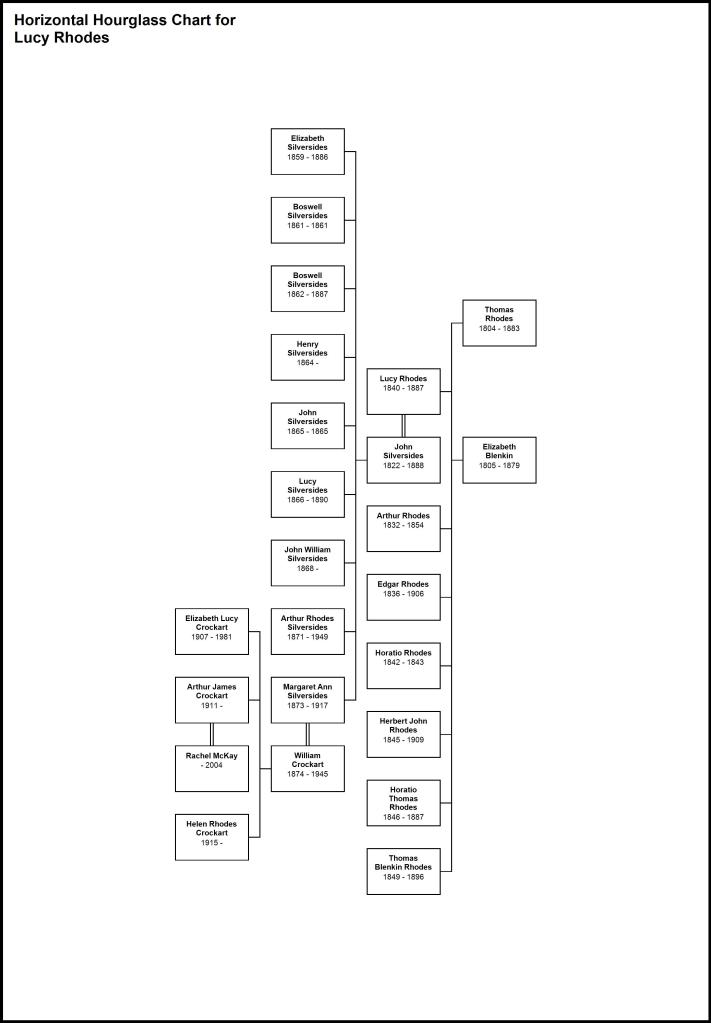
In the 1861 census John, Lucy and their daughter Elizabeth (1859-1886) were living in Riccall where John was described as a farmer of 100 acres employing two labourers. John and Lucy had nine children: six boys and three girls. Two of their sons died in infancy, three children in their twenties, two sons have been difficult to trace and just one of their children definitely married: Margaret Ann Silversides (1873-1917). In 1891 their son Arthur Rhodes Silversides (1871-1949) was a footman at The Villa in Escrick; a property where I once owned an apartment. By 1901 he had become a butler; when he died on 11 January 1949 in York, he left effects to the value of £1,784 8s 9d. The following chart shows John, Lucy and their family.

Arthur’s mother Lucy faired rather differently. By the 1881 census John, Lucy and six of their children (Elizabeth, Boswell, Henry, John, Arthur and Margaret) were living in Dam End in Riccall. Their daughter Lucy was living with her aunt and uncle. By now John was aged 59 and described as an agricultural labourer, as were their sons Boswell and Henry. Boswell and Henry were recorded as joining the police in Leeds in 1885. Daughter Elizabeth died in 1886 and sons John and Arthur and daughter Margaret were elsewhere in 1891. Perhaps by the time Lucy was admitted to the Broadgate hospital in 1887 she had been affected by significant changes in her family life.

Lucy was admitted to Broadgate from the Selby Union on 1 March 1887. The case book mentioned that her first mental health attack had lasted for eight months. It is interesting to note that she entered the asylum from the Selby Union. She was described as being aged 50, married and her religion was Church of England. With regards to her mental health, she was of a nervous temperament, dangerous and with her form of insanity described as mania. She was said to be excited and “the patient talks to herself”.

Her physical condition was described as tall, poorly nourished and dirty. The case book then goes onto outline her mental and physical state after her admission. On 4 March “her conversation was silly and voluble”. By 11 March Lucy was “physically in a very bad state and appears to be getting weaker daily…she is nervous and excited and most difficult to manage in short nothing can be done with her…she won’t eat.” It went onto say that “the diet for the most part consists of butter, eggs milk mixture with brandy”. Lucy had diarrhoea.

Lucy died on 13 March 1887 at 8.50pm in the presence of nurse Phebe Allan. Her cause of death was Phthisis. An autopsy was carried out and the record certified by the asylum Medical Superintendent Dr Murdoch Donald McLeod. After her death Lucy was buried in St Mary’s churchyard, Riccall. Her husband John died just over a year later on 16 March 1888. He too was buried in the churchyard. After his death the cottage he was living and his household furniture were sold at auction by Thomas Walker Auctioneers, according to the York Herald dated 14 April 1888. Perhaps by then none of his children were around to take an interest in his furniture.

So far, I’ve been unable to trace what happened to two of John and Lucy’s sons: Henry  Silversides (born 1864) and John William Silversides (born 1868). Do let me know if you have any stories about the family which you are willing to share with me.

Note: the map used in this blog has been reproduced with the permission of the National Library of Scotland under the following creative commons licence https://creativecommons.org/licenses/by-nc-sa/4.0/ and sourced from the NLS maps site https://maps.nls.uk/.

Bibliography:

Births, marriages and deaths. https://www.ancestry.co.uk/ : accessed May 2023.

Broadgate asylum. https://www.countyasylums.co.uk/broadgate-beverly/ : accessed May 2023.

Broadgate hospital case books. NH/6/64/20, pp 131-132.

Census records. https://www.ancestry.co.uk/ : accessed May 2023.

Lewis, Samuel ed. (1848) A Topological Directory of England. London: Lewis. https://www.british-history.ac.uk/topographical-dict/england : accessed May 2023.

OS Map. https://maps.nls.uk/ : accessed May 2023.

Probate records. https://www.ancestry.co.uk/ : accessed May 2023.

Riccall. https://www.genuki.org.uk/big/eng/YKS/ERY/Riccall : accessed May 2023.

West Yorkshire, England Police Records, 1833-1914. https://www.ancestry.co.uk/ : accessed May 2023.

Yorkshire baptisms, marriages and burials. https://www.findmypast.co.uk/ : accessed May 2023.

Hannah Silversides 1796-1845

During a recent visit to the East Riding of Yorkshire archives at Beverley, I decided to review a number of documents I’d identified in their online catalogue which I thought might be relevant to my own family history.

I came across a bastardy order (QSU1/40/50 ) dated 1 July 1839 which named William Rooke as the putative father of a female child born to Mother Hannah Silversides. The Selby Guardians of the Poor had an interest in bringing the case as the child had been born in the parish of Riccall and as such the child was chargeable to the parish.

William Rooke was ordered to pay a sum, not exceeding one shilling per week, to the overseers of the poor of the parish of Riccall, for maintenance of the child. The order included the requirement that the sum should be paid until the child attained the age of 7 years.

I decided to find out more about Hannah to see if she was related to the Silversides in my family tree and thus to myself. My research revealed that Hannah, whose maiden name was Mitchel, was the second wife of Robert Silversides (1768-1829), my 5th great grand uncle. Robert and Hannah were married in St Mary’s Church, Riccall on 27th September 1821 by banns. Robert was described as a farmer and widower and Hannah a spinster. Robert signed the marriage record but Hannah signed using her mark. One of the witnesses was Guy Silversides, Robert’s brother, although quite a few male members of the family have the first name Guy.

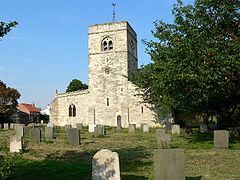
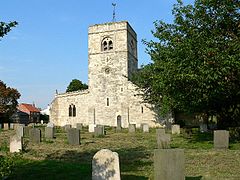
St Mary's Church, Riccall

Robert and Hannah had a son John baptised in the same church on 11 July 1824. Just five years later, Robert was buried in St Mary’s churchyard on 20 February 1829 when he was described as a labourer. With his first wife Sarah Riley (1772-1815) he had had at least seven children, four boys and three girls. Perhaps his fortunes had changed and Hannah experienced difficulties after his death. It looks like her son John was working in Bossall in the North Riding of Yorkshire when he married his wife Jane Wilson on 17 February 1845.

Returning now though to William Rooke and the bastardy notice. It does seem that he may well have been the father of Hannah’s second child Ann Silversides who was baptised on 24 November 1839 in St Mary’s Church, Riccall. Her baptism records her as the illegitimate child of Hannah Silversides, widow. Both Hannah and Ann were recorded in the 1841 census in Wheel Hall, Riccall with Hannah described as a labourer. Wheel Hall was originally a manor house but was replaced in the 18th century by a farmhouse.

Hannah died in 1845 and was buried in St Mary’s Churchyard on 5 May 1845. What happened to her daughter Ann is not clear, nor is the identity of her father. There was a William Rooke recorded in the 1841 census at Riccall Hall who was an agricultural labourer born about 1816.  No further information on him in Riccall has been found. If you any information on either of Ann Silversides or William Rooke do, please contact me.

Research update

In the last few months I have spent time at the archives in Beverley, Borthwick Institute in York and the Society of Genealogists library in London, as well as much time searching the internet. It was sad and exciting to hold the actual documents which recorded my ancestor Thomas King’s guilty verdict and sentence to be transported to the colonies for stealing chickens. My query about him to the Tasmanian Information and Research Centre was handled thoughtfully and I am working through the information they sent.

I do though still have some brick walls to deal with,; parrticularly in relation to the Sarginsons. A seminar at the Society of Genealogists on searching Yorkshire records has though give me some leads to follow. If you have any information about your Sarginson ancestors do get in touch using the contact button as I am also in the early stages of a one name study of Sarginsons.