Category Archives: Palframan

John Palframan 1817-1874

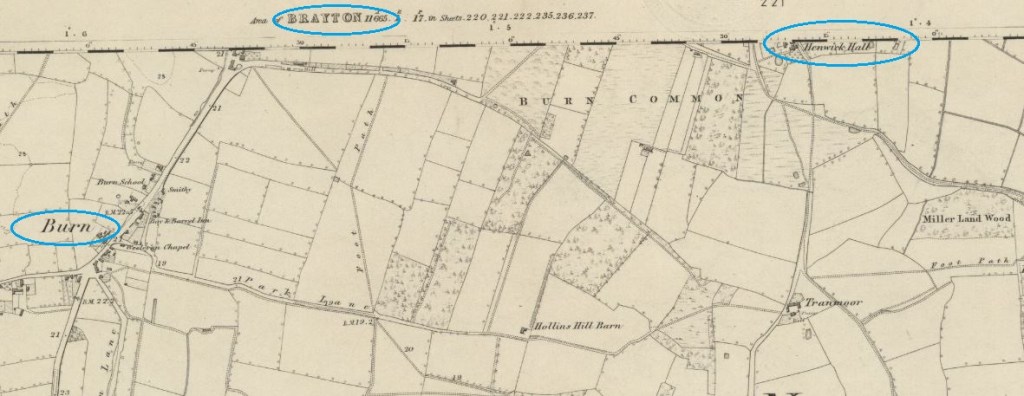
John, my first cousin four times removed, was baptised on 5 July 1817 in Brayton, Yorkshire. His parents were Thomas Palframan (1786-1858) a farmer, and Mary Ann Brabs (1792-1852). John married Sarah Otley, by licence, on 22 September 1846 in Brayton parish church. He was a bachelor and farmer from Henwick Hall in nearby Burn and Sarah (1818-1872) a spinster from Brayton. Together they had nine children, six daughters and three sons, although one son died in infancy. (The following map is OS Yorkshire sheet 236 published in 1853 and shows the location of Henwick Hall.)
By the 1851 census the family had moved to Old Ouse, Wistow where John was a farmer of 76 acres. By 1861 he was farming 80 acres and employed one man and two boys and in 1871 he was farming 86 acres with two farm labourers. John’s wife Sarah died on 25 November 1872 and was buried on 27 November in All Saints, Wistow churchyard. On her burial record her location in Wistow was given as Wistow Lordship. Not long after his wife’s death John made his last will and testament which was dated 20 January 1873.
John died on 11 April 1874. At the time of his death two of his daughters, Joanna (1848-1902) and Mary (1846-1916), were married and the ages of his other six children were as follows:

  • Daughters Amplias 25 (1849-1878), Emily 22 (1852-1927), Annie 21 (1853-1939) and Elizabeth 19 (1855-1883).
  • Sons John 17 (1856-1924) and Ot(t)ley 13 (1861-1937).

Unusually for members of my family John left a will with effects of less than £600. His married daughters, Joanna and Mary, were left £19 19s each with the specific request that the money was for them and not their husbands. Sons John and Otley were left £50 each on the basis they received the bequest when they were 21. John’s remaining goods, chattels etc were to be divided equally among his six unmarried children. His farming stock, horses, cattle, carts and carriages, hay, corn and all other produce on the farm and his tenant rights and insurances were left in trust. The trustees were his friends George Riley of Henwick Hall, farmer, Robert Hodgson of Selby, Gentleman and Henry Dixon of Wistow, shopkeeper.

John requested in his will that his tenanted farm should carry on after his death, to benefit his six unmarried children, until his youngest son Otley was 21, which would have been in 1882. There was a further request that the farm stock should be offered to John when he was 21. John senior’s executors were George Riley, Henry Dixon and Robert Hogson.

John’s will was proved at Wakefield and his executors posted a notice in the Selby Times (31 July 1874, p1) requesting that his creditors came forward with their claims on John’s estate by 1 September 1874. After that date the executors intended to distribute his assets according to his will.

It seems there may have been difficulties managing John’s affairs after his death. Notices were submitted to the Selby Times on 13, 20 and 27 October 1876 advising that John Palframan the younger was ‘no longer authorised to transact business’ on behalf of the executors (George Riley and Henry Dixon). And that they ‘are not answerable to any business debt or claim’ that anyone may have against him.

Although Otley had not reached the age of 21 by 1877, the farm and two closes of excellent land (lots 2 and 3) occupied by the trustees of John, appeared in an advert for sale by auction in the Selby Times (29 June 1877, p1). Lot 1 was a farm in Wistow occupied by Mr William Varley and lot 4 a house and premises in Sherburn St, Cawood occupied by Mr John Farrer. The properties were said to be ‘Copyhold of the manors of Wistow and Cawood where the Fine is small and certain’. At this stage it wasn’t clear who the owner of the four lots was, just that the auctioneer was Mr Acton and the auction was to be held at the Londesborough Arms Hotel in Selby on 10 July 1877 at 5pm.

Further information from the Selby Times (20 July 1877, p1) indicated that lots 1 and 2 were not sold and that lot 3 was bought by Mr T Jackson of Cawood Hagg for £350. Lot 2 consisted of 64 acres 0 roods 8 perches of land, a farm house and buildings and that the price reached £4,700 before the lot was withdrawn from sale. The lots were the residue of Mr Morritt’s estate, which had mostly been sold in the autumn of 1876. A full list of the lots sold then had appeared in the Selby Times (10 November 1876, p4). Lots 55 and 56, in the occupation of Mr Palframan, were the two lots later withdrawn from sale in 1877. The owner of the properties was R A Morritt esq of Rokeby, county Durham. The Morritt family had been landlords in the area for many years and memorials to them are in Wistow church. R A Morritt (1816-1890) had retained some interest in Wistow as he donated £25 to the Wistow new school building fund in 1877 (Selby Times 23 March 1877, p1).

A further request from John’s trustees, regarding outstanding debts for his estate, was made in the Selby Times of 15 February 1878. The intention was to distribute his assets to those parties entitled to receive them. Not long after this date, the Selby Times of 21 June 1878 reported on the results of a case at Selby County Court brought by E Shearsmith potato merchant against George Riley and Henry Dixon, trustees. He had lent a saddle to John the younger in September 1877. When he learnt that the trustees were selling the farming stock he went to them and asked them not to sell it. The saddle was sold by the auctioneer. Shearsmith was awarded 12s 6d with costs. The Justice of the Peace remarked that ‘if trustees would act in an overbearing manner, they must take the consequences’.

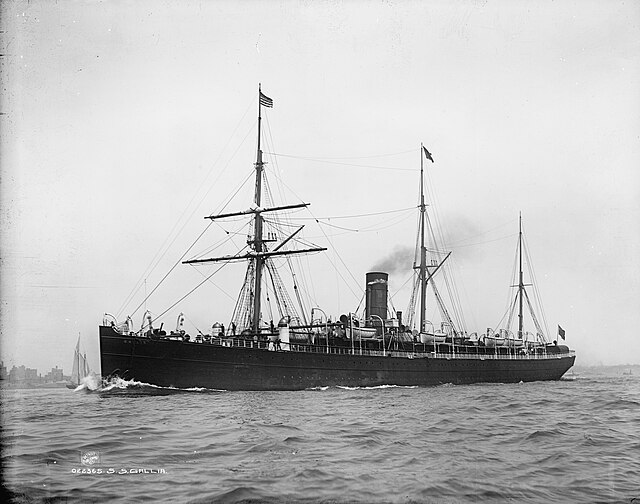
The next twist in this story involved John’s two sons, John and Otley. Together they left Liverpool on 12 November 1881 on the ship Gallia (see following image). On arrival in New York on 25 November 1881, they were described as farmers bound for Canada. While John made a life for himself in Ontario, Canada, Otley returned to Wistow where he married Elizabeth Lacy (1861-1938), on 30 June 1883, in Wistow parish church. Unfortunately, Otley was an unsuccessful farmer and was declared bankrupt in 1895 (York Herald 3 May 1895, p3). Otley was buried in St Peter and St Paul, Drax churchyard on 6 June 1937.
John and Otley’s eldest sister Mary, a widow, emigrated to Canada with her children Ellen (Helen), Louise and John together with Ellen’s husband Edward Bridgeman. They left Liverpool on 11 January 1894 on the ship Mongolian, bound for Halifax, Nova Scotia. It seems likely that Mary’s son Otley Palframan Turner preceded them to Canada, but a passenger list record has so far not been found for him. Mary died on 7 September 1916 in Toronto, Canada and was buried in Mount Pleasant cemetery. York, Ontario. When her brother John died on 26 June 1924 he was buried in Prospect cemetery, another Toronto Trust Cemetery, in a grave owned by his wife Frances Wheeler (1858-1938).

Finally

I would like to know more about the people mentioned in this blog post. Do contact me if you have any further information which you are willing to share with me.

Notes:

The map used in this blog has been reproduced with the permission of the National Library of Scotland under the following creative commons licence https://creativecommons.org/licenses/by-nc-sa/4.0/ and sourced from the NLS maps site https://maps.nls.uk/.

Bibliography:

Births, marriages and deaths. https://www.ancestry.co.uk/ : accessed July 2025.

Canadian Passengers Lists, 1865-1935. https://www.ancestry.co.uk/ : accessed July 2025.

Census records. https://www.ancestry.co.uk/ : accessed July 2025.

England and Wales, National Probate Calendar (Index of Wills and Administrations), 1858-1966. https://www.ancestry.co.uk/ : accessed July 2025.

New York, US, Arriving Passengers & Crew Lists (including Castle Garden & Ellis Island), 1820-1957. https://www.ancestry.co.uk/ : accessed July 2025.

Ontario, Canada ,Deaths and Deaths Overseas, 1869-1947. https://www.ancestry.co.uk/ : accessed July 2025.

Ontario, Canada Marriages, 1735-1985. https://www.ancestry.co.uk/ : accessed July 2025.

Ontario, Canada, Toronto Trust Cemeteries, 1826-1929 https://www.ancestry.co.uk/ : accessed July 2025.

OS Map. https://maps.nls.uk/ : accessed July 2025.

Selby Times. https://www.findmypast.co.uk/ : accessed July 2025.

Ship Gallia. https://commons.wikimedia.org/wiki/Main_Page : accessed July 2025.

UK and Ireland, Find A Grave Index, 1300s to Current. https://www.ancestry.co.uk/ : accessed July 2025.

Yorkshire baptisms, marriages and burials. https://www.findmypast.co.uk/ : accessed July 2025.

York Herald. https://www.findmypast.co.uk/ : accessed July 2025.
Mary Isabel Palframan and Jack Dickinson

I’ve been going through my pile of unread books to sort them out and came across one written by John Dickinson about his parents Jack and Mary Dickinson. A school friend mentioned the book to me some time ago and I thought it was about time I read it. The book provides a real insight into the life of Mary, a domestic servant in the early part of the 20th century, before she met her future husband, Jack. It also provides an account of their lives and the impact of two World Wars on them. This blog post is just going to focus on my connection to Mary and her husband Jack and makes use of the 1921 census. The book provides key insights into the life of a couple who are related to me and it’s well worth getting hold of a copy.

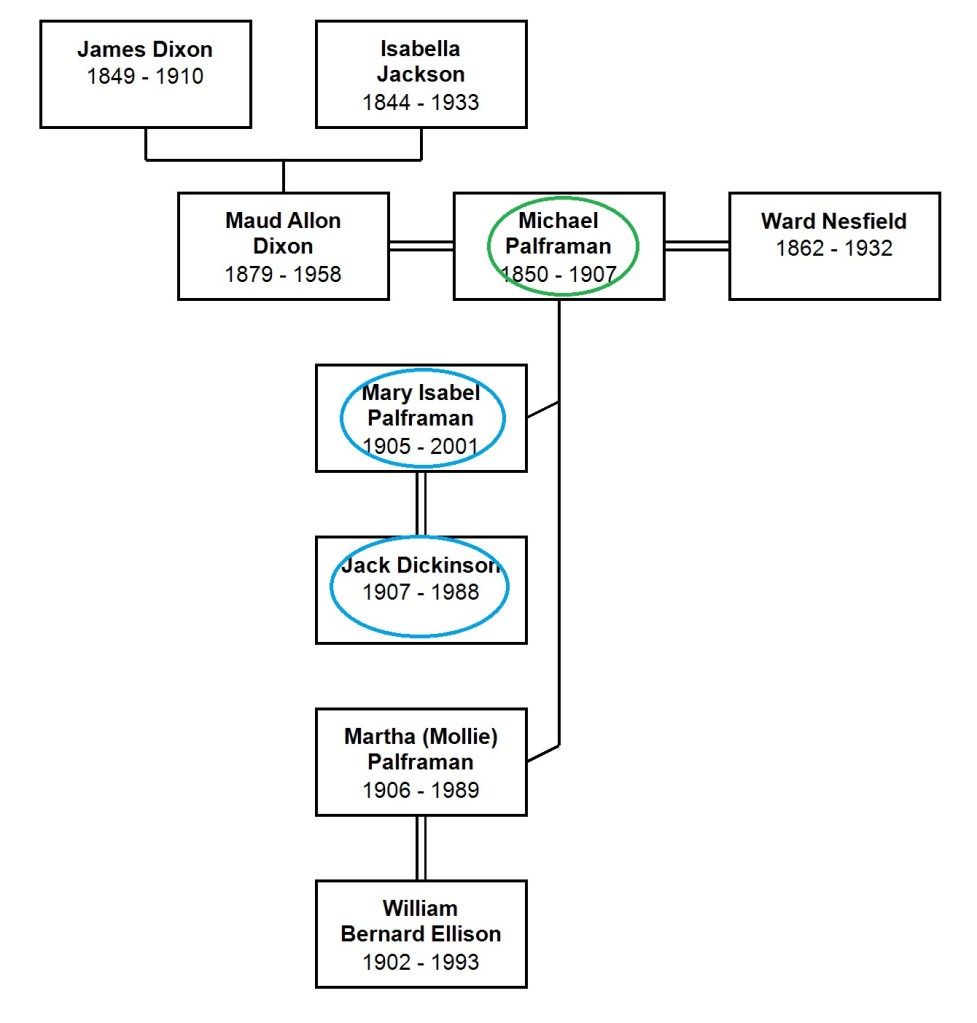
Mary Isabel Palframan (1905-2001), my first cousin three times removed, was the eldest daughter of Michael Palframan (1850-1907), my second great grand uncle and Maud Allon Dixon (1879-1958). Michael was farmer in South Duffield, Yorkshire in the 1901 census and he married Maud, a school teacher, in 1904. Michael died not long after his second daughter was born. After his death Maud moved with her two daughters to Harwood Dale in the North Riding of Yorkshire where she worked as a teacher at the Harwood Dale elementary school. Maud married Ward Nesfield (1862-1932), a widower and farmer, 27 August 1912 in Scarborough. The following chart shows the key family relationships:

Family history chart for Michael and Maud

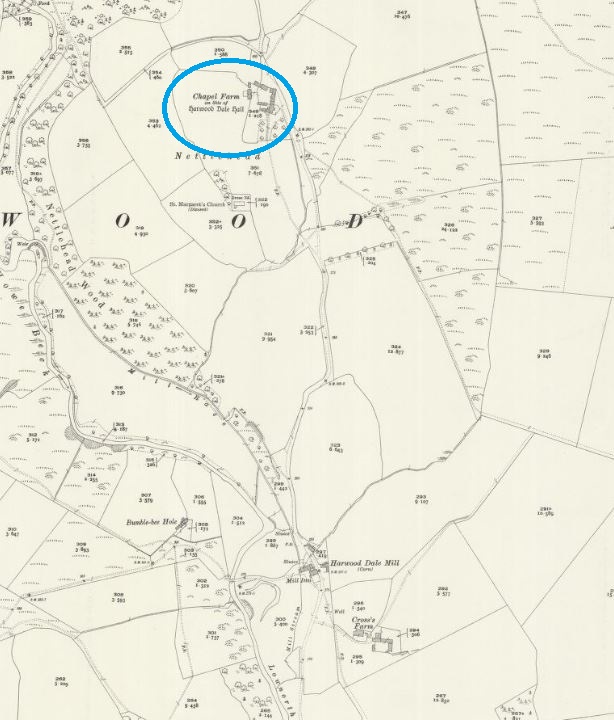
By the 1921 census Ward, Maud, Ward’s son Edward and Maud’s daughter Martha were living at Chapel Farm, Harwood Dale. The Dale is in the parish of Hackness and is eight miles north west of Scarborough; it is highlighted on the following map:

OS Yorkshire LX.II date 1928

Maud’s eldest daughter Mary was working as a domestic servant in the household of W H Wordsworth Esquire of The Glen, Scalby, Yorkshire. In contrast, her future husband Jack Dickinson, was in Leeds with his mother Isabella (1886-1970), her partner/husband Edward Dickinson (1871-1935) and three siblings. The family of six were living in four rooms, with Edward working as a labourer for a building company. They had moved to Scarborough by 1935 as that is where Edward’s death was registered.

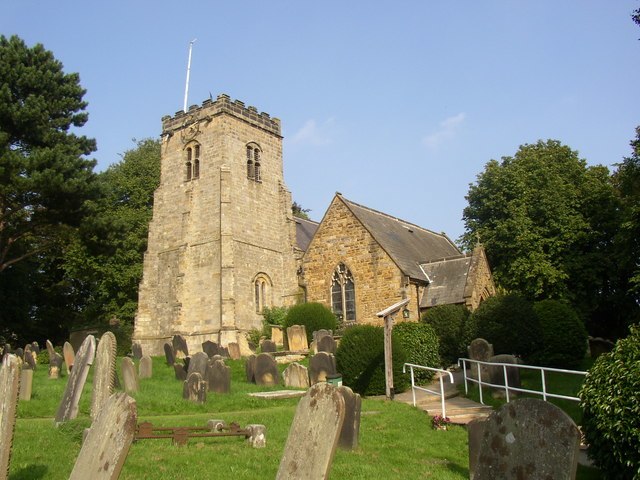
Mary met Jack in Scarborough and they married on 14 February 1940 in St Lawrence’s Church, Scalby, just before Jack returned to his military unit and WWII.

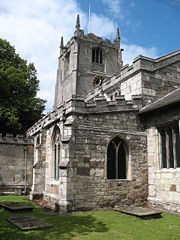
St Lawrence’s Church, Scalby

Jack died in Scarborough in 1998 and Mary died at the age of 96 in 2001.

It has been interesting to find out more about this family. I spent time working in Scarborough when I was a student and did not know anything about them. Now I have just two more books on my unread pile to browse and decide what to do with!

Lastly – I would like to know more about the people mentioned in this blog post. Do contact me if you have any further information which you are willing to share.

Notes:

The map used in this blog has been reproduced with the permission of the National Library of Scotland under the following creative commons licence https://creativecommons.org/licenses/by-nc-sa/4.0/ and sourced from the NLS maps site https://maps.nls.uk/.

The image of St Lawrence’s Church was sourced from Wikimedia Commons – Creative Commons Attribution-Share Alike 2.0 – https://creativecommons.org/licenses/by-nc-sa/2.0/.

Bibliography:

1921 Census. https://www.findmypast.co.uk : accessed July 2022.

Births, marriages and deaths. https://www.ancestry.co.uk/ : accessed July 2022.

Bolton, Humphrey. (2006) St Lawrence’s Church, Scalby. https://commons.wikimedia.org/wiki/Main_Page : accessed July 2022.

Census records. https://www.ancestry.co.uk/ : accessed July 2022.

Dickinson, John. (2011) Fine Wife you turned Out to be! Scarborough: Farthings Publishing.

England and Wales, National Probate Calendar (Index of Wills and Administrations), 1858-1995. https://www.ancestry.co.uk/ : accessed July 2022.

Hackness. https://www.genuki.org.uk/big/eng/YKS/NRY/Hackness : accessed July 2022.

OS Maps. https://maps.nls.uk/ : accessed July 2022.

Scalby. https://www.genuki.org.uk/big/eng/YKS/NRY/Scalby : accessed July 2022.

Palframan family – changing occupations

While researching my family history I have come across a number of unusual surnames and this blog post in the first in a series I plan to write about them. I’ve chosen Palframan for my initial post, in part because it is an interesting occupational surname, and also, because it leads to one of my many brick walls.

Origin of surname

According to the Oxford Dictionary of Family Names in Britain and Ireland, Palfreyman, plus its variants Palphreyman, Palfreman, Palfreeman, Palframan and Parfrement, is an occupational surname from the Middle English palefreiman; a man responsible for the palfrey’s or riding horses, alternatively a groom. In the 1881 census there were 645 occurrences of the name, mainly in the West Riding of Yorkshire and Derbyshire. Interestingly, Redmonds, in his book on Yorkshire surnames, describes another possible spelling variant, Palphramand, and describes the surname as reflecting the man in charge of the palfreys, or saddle horses. He also explained that in 1881 the surname Palframan was most prominent in Selby with Palframand in York and Palfreeman in York and Pocklington.

My ancestral connections

My ancestors mostly use the variant Palframan, although the records for my five times great grandfather, Michael (1722-1812), also include the variant Palfreyman.  Michael died in Pontefract, West Riding of Yorkshire and his burial record gives his age as 90, suggesting he was born about 1722, and that he was a hatter. He was apprenticed to Joseph Rawnsley, a hatter, of Pontefract and his stamp duty was paid in 1740 for his apprenticeship. By 1753 Michael was master to an apprentice, Thomas Thresh, and his occupation given as a felt maker. Despite searching I’ve been unable to find his baptism and parents. I do have a working theory but need more evidence to prove a link. Michael’s 1740 apprenticeship record gave his father’s name as Michael.

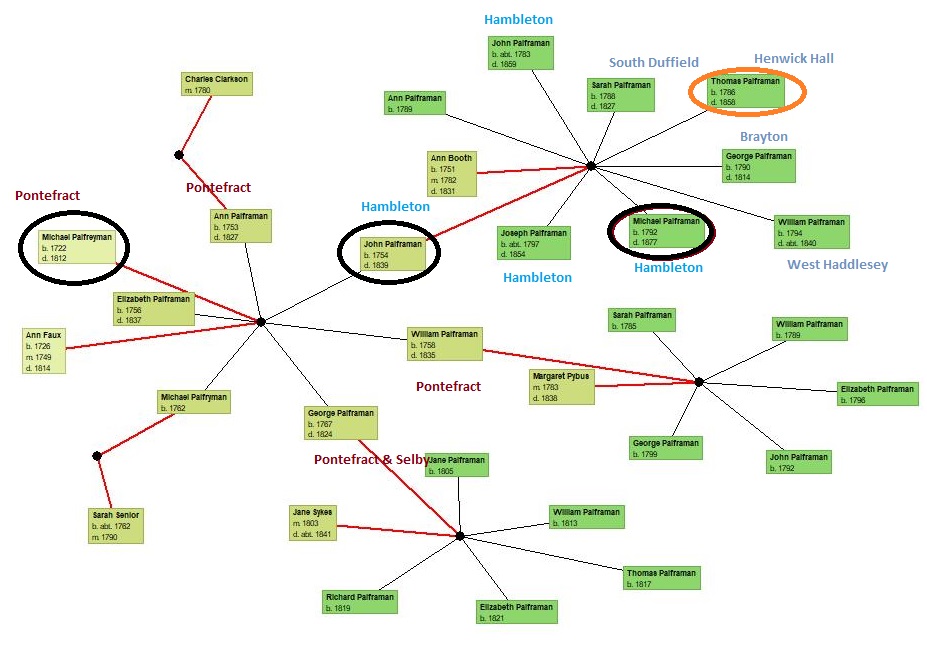
The following chart shows Michael and two generations of his descendants. The people circled in black are, reading from left to right, my five times great grandfather Michael, my four times great grandfather John (1754-1839) and my three times great grandfather Michael (1782-1877) who was the father of my two times great grandmother Sarah (1845-1920). Thomas Palframan, annotated in orange at the top of the chart, is the father of my first cousin four times removed, John (1817-1874), who moved to farm in Wistow, Yorkshire and whom more about later. The chart has also been annotated to show where in Yorkshire each family group lived.

Dandelion chart for the Palframan family

Hambleton is 9 miles (about 13 km) from Pontefract and I was intrigued as to why my four times great grandfather John (1754-1839) moved from Pontefract to Hambleton.

John Palframan (1754-1839)

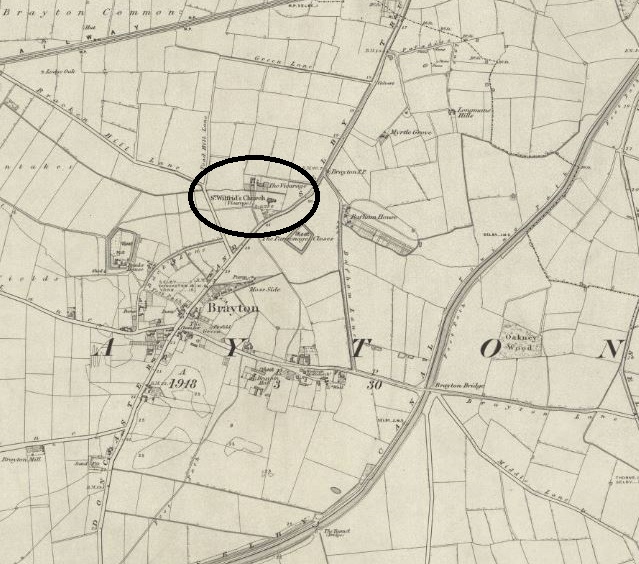
John was baptised on 19 August 1754 in St Giles and St Mary’s church, Pontefract. He married Ann Booth (1751-1831) in the same church on 12 December 1782. They had six sons and two daughters and were living in Hambleton by the time their second son Thomas (1756-1858) was baptised in St Wilfrid’s Church, Brayton. The following map shows the layout of Brayton in 1851; St Wilfrid’s church is marked with a circle.

OS Yorkshire 221 dated 1851

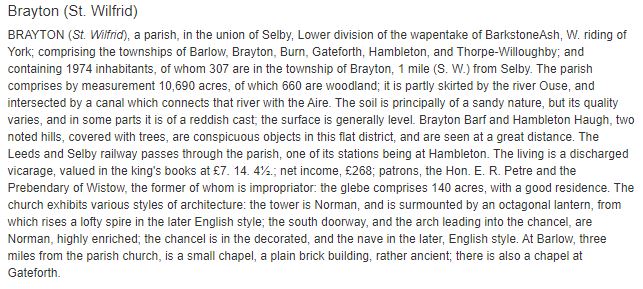
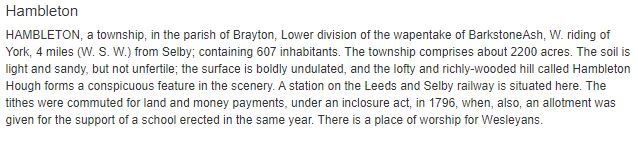
Brayton and Hambleton were largely agricultural areas as described in the following two extracts from Lewis’s topological directory of England dated 1848. At that time only Brayton had a parish church and this is where John and his wife continued to baptise their children.

Description of Brayton from Lewis’ Topographical Directory
Description of Hambleton from Lewis’ Topographical Directory

Whilst living in Hambleton John was recorded as possessing an alehouse licence in 1803 and in 1810 he appeared in land tax records showing that he occupied land owned by the Vicar of Brayton and William Bew senior.   By 1822 he still occupied land owned by William Bew and the Reverend Richard Paver. In the same land tax record his son John (1883-1859) was recorded as occupying land owned by the Hon. Edward Petre, who later became the Mayor of York in 1830.  

John died in January 1839 and was buried on 13 January 1839 in Brayton parish church. The ceremony was conducted by the Vicar of Brayton, the Reverend Richard Paver, the owner of the land he occupied in Hambleton.

John and Ann’s fourth son, Michael Palframan (1792-1877), is my three times great grandfather.  He married his first wife Sarah Slater (1797-1834), on 3 March 1823 in Brayton. They had seven children, four boys and three girls.

By 1832 Michael was also occupying a house and land owned by the Hon. Edward Petre and in the same year Michael appeared in the Poll Book for Hambleton as the occupier of a “farm above £50 per year”. His brother John and Joseph also appeared in the same Poll Book.

Soon after Michael’s first wife Sarah died, he married Martha Seymour (1813-1889), on 26 December 1835. They had nine children: five boys and four girls. I am descended from their daughter, Sarah (1845-1920), my two times great grandmother.

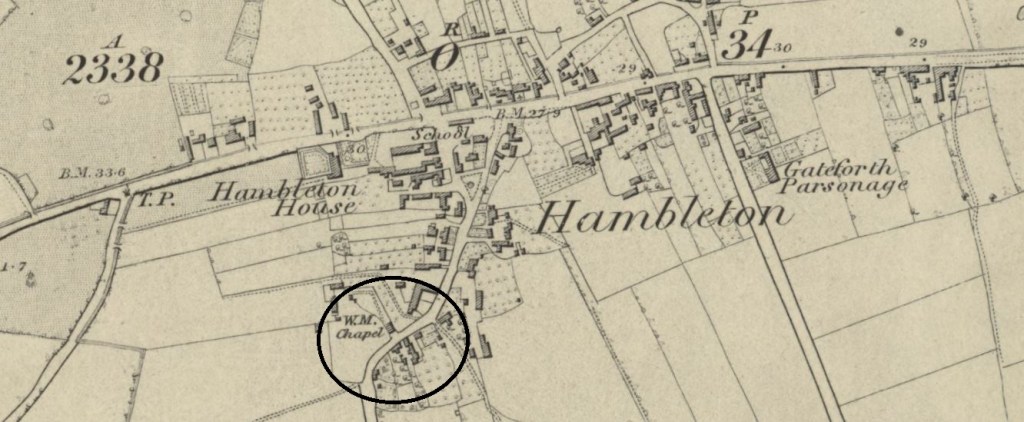
By the 1841 census Michael was described as a farmer in Hambleton. The following map shows the layout of Hambleton in 1850 with a circle around the Wesleyan Chapel.

OS Yorkshire 220 map dated 1850

By 1871 Michael farmed 96 acres and employed three labourers. He lived in Chapel Street, Hambleton. The approximate position of the street can be seen in the above map as the Wesleyan Chapel is located on it.

When Michael died on 25 February 1877 he was described as a farmer from Hambleton and his sons George and Michael, also farmers from Hambleton, were his executors. Michael left effects valued under £450.

Thomas Palframan (1786-1858) and John Palframan (1817-1874)

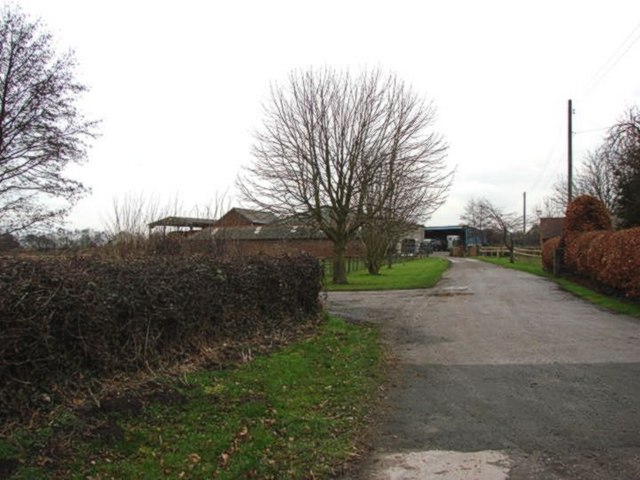
Thomas was the brother of my three times great grandfather, Michael; i.e., my 4th great uncle. He too became a farmer and by 1832 was farming at Henwick Hall, Burn where the Poll Book recorded him as a “Farmer £50 rent” per year. He continued to farm at Henwick Hall and the 1851 census recorded that he was a farmer of 164 acres employing two men. He was still living at Henwick Hall when he died on 17 March 1858 leaving effects under £600. The following is a modern photograph of Henwick Hall farm:

Modern photograph of Henwick Hall Farm by Bill Henderson/CC BY-SA 2.0

Thomas’ eldest son John (1817-1874) left Burn to farm in Wistow. He was recorded in the 1871 census as a farmer of 86 acres who employed two labourers at “Old Ouse”. John is buried with his wife Sarah Otley (1818-1872) in the churchyard of All Saints Church, Wistow. The majority of their children stayed in Yorkshire except their daughter Mary (1847-1916) and son John (1856-1924) who both emigrated to Ontario, Canada

Finally, the brick wall

I am intrigued as to how the son of a hatter from Pontefract came to move to a more rural area where he kept an alehouse, and also perhaps, became a small farmer. I would like to know more about all the people mentioned in this blog post, and in particular, if there is any information about the parents of my five times great grandfather Michael, the hatter/felt maker, from Pontefract. It seems his father was called Michael. Do contact me if you have any further information which you are willing to share.

Note: the maps used in this blog have been reproduced with the permission of the National Library of Scotland under the following creative commons licence https://creativecommons.org/licenses/by-nc-sa/4.0/ and sourced from the NLS maps site https://maps.nls.uk/.

Bibliography

Bill Henderson/Henwick Hall Farm via Wikimedia Commons/CC BY-SA 2.0

Brayton. https://www.genuki.org.uk/big/eng/YKS/WRY/Brayton : accessed May 2021.

Census records. https://www.ancestry.co.uk/ : accessed May 2021.

England and Wales, National Probate Calendar (Index of Wills and Administrations), 1858-1995. https://www.ancestry.co.uk/ : accessed May 2021.

Hanks, Patrick et al. (2016.) The Oxford Dictionary of Family Names in Britain and Ireland. Oxford: Oxford University Press.  

OS Maps. https://maps.nls.uk/ : accessed May 2021.

Lewis, Samuel ed. (1848) A Topological Directory of England. London: Lewis. https://www.british-history.ac.uk/topographical-dict/england : accessed May 2021.

Petre, Hon. Edward. https://www.historyofparliamentonline.org/volume/1820-1832/member/petre-hon-edward-1794-1848 : accessed May 2021.

Redmonds, George. ((2015) A Dictionary of Yorkshire Surnames. Donington: Shaum Tyas.  

UK, Poll Books and Electoral Registers, 1538-1893. https://www.ancestry.co.uk/ : accessed May 2021.

UK, Register of Duties Paid for Apprentice’s Indentures, 1710-1811. https://www.ancestry.co.uk/ : accessed May 2021.

Vision of Britain. https://www.visionofbritain.org.uk/ : accessed May 2021.

West Yorkshire, England, Alehouse Licences, 1771-1962. https://www.ancestry.co.uk/ : accessed May 2021.

West Yorkshire, England, Church of England Baptisms, Marriages and Burials, 1512-1812. https://www.ancestry.co.uk/ : accessed May 2021.

West Yorkshire, England, Select Land Tax Records, 1704-1932. https://www.ancestry.co.uk/ : accessed May 2021.

Yorkshire baptisms, marriages and burials. https://www.findmypast.co.uk/ : accessed May 2021.