Tag Archives: Canada

John Palframan 1817-1874

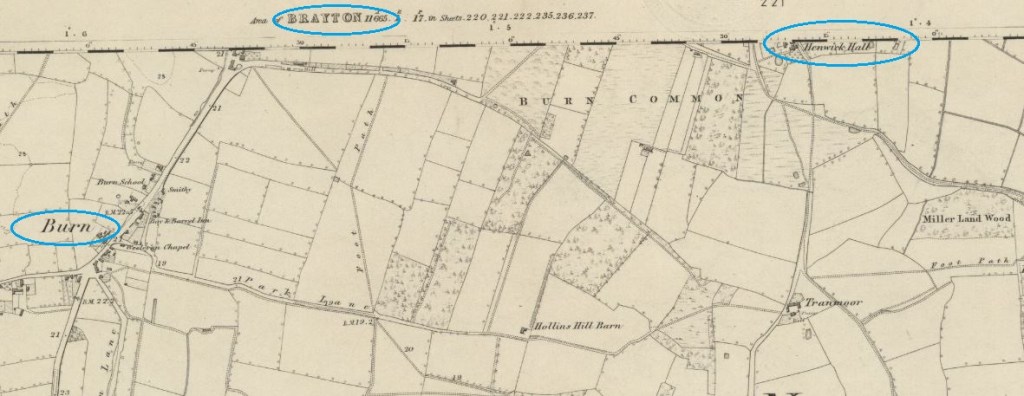
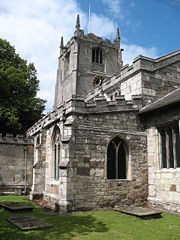
John, my first cousin four times removed, was baptised on 5 July 1817 in Brayton, Yorkshire. His parents were Thomas Palframan (1786-1858) a farmer, and Mary Ann Brabs (1792-1852). John married Sarah Otley, by licence, on 22 September 1846 in Brayton parish church. He was a bachelor and farmer from Henwick Hall in nearby Burn and Sarah (1818-1872) a spinster from Brayton. Together they had nine children, six daughters and three sons, although one son died in infancy. (The following map is OS Yorkshire sheet 236 published in 1853 and shows the location of Henwick Hall.)
By the 1851 census the family had moved to Old Ouse, Wistow where John was a farmer of 76 acres. By 1861 he was farming 80 acres and employed one man and two boys and in 1871 he was farming 86 acres with two farm labourers. John’s wife Sarah died on 25 November 1872 and was buried on 27 November in All Saints, Wistow churchyard. On her burial record her location in Wistow was given as Wistow Lordship. Not long after his wife’s death John made his last will and testament which was dated 20 January 1873.
John died on 11 April 1874. At the time of his death two of his daughters, Joanna (1848-1902) and Mary (1846-1916), were married and the ages of his other six children were as follows:

  • Daughters Amplias 25 (1849-1878), Emily 22 (1852-1927), Annie 21 (1853-1939) and Elizabeth 19 (1855-1883).
  • Sons John 17 (1856-1924) and Ot(t)ley 13 (1861-1937).

Unusually for members of my family John left a will with effects of less than £600. His married daughters, Joanna and Mary, were left £19 19s each with the specific request that the money was for them and not their husbands. Sons John and Otley were left £50 each on the basis they received the bequest when they were 21. John’s remaining goods, chattels etc were to be divided equally among his six unmarried children. His farming stock, horses, cattle, carts and carriages, hay, corn and all other produce on the farm and his tenant rights and insurances were left in trust. The trustees were his friends George Riley of Henwick Hall, farmer, Robert Hodgson of Selby, Gentleman and Henry Dixon of Wistow, shopkeeper.

John requested in his will that his tenanted farm should carry on after his death, to benefit his six unmarried children, until his youngest son Otley was 21, which would have been in 1882. There was a further request that the farm stock should be offered to John when he was 21. John senior’s executors were George Riley, Henry Dixon and Robert Hogson.

John’s will was proved at Wakefield and his executors posted a notice in the Selby Times (31 July 1874, p1) requesting that his creditors came forward with their claims on John’s estate by 1 September 1874. After that date the executors intended to distribute his assets according to his will.

It seems there may have been difficulties managing John’s affairs after his death. Notices were submitted to the Selby Times on 13, 20 and 27 October 1876 advising that John Palframan the younger was ‘no longer authorised to transact business’ on behalf of the executors (George Riley and Henry Dixon). And that they ‘are not answerable to any business debt or claim’ that anyone may have against him.

Although Otley had not reached the age of 21 by 1877, the farm and two closes of excellent land (lots 2 and 3) occupied by the trustees of John, appeared in an advert for sale by auction in the Selby Times (29 June 1877, p1). Lot 1 was a farm in Wistow occupied by Mr William Varley and lot 4 a house and premises in Sherburn St, Cawood occupied by Mr John Farrer. The properties were said to be ‘Copyhold of the manors of Wistow and Cawood where the Fine is small and certain’. At this stage it wasn’t clear who the owner of the four lots was, just that the auctioneer was Mr Acton and the auction was to be held at the Londesborough Arms Hotel in Selby on 10 July 1877 at 5pm.

Further information from the Selby Times (20 July 1877, p1) indicated that lots 1 and 2 were not sold and that lot 3 was bought by Mr T Jackson of Cawood Hagg for £350. Lot 2 consisted of 64 acres 0 roods 8 perches of land, a farm house and buildings and that the price reached £4,700 before the lot was withdrawn from sale. The lots were the residue of Mr Morritt’s estate, which had mostly been sold in the autumn of 1876. A full list of the lots sold then had appeared in the Selby Times (10 November 1876, p4). Lots 55 and 56, in the occupation of Mr Palframan, were the two lots later withdrawn from sale in 1877. The owner of the properties was R A Morritt esq of Rokeby, county Durham. The Morritt family had been landlords in the area for many years and memorials to them are in Wistow church. R A Morritt (1816-1890) had retained some interest in Wistow as he donated £25 to the Wistow new school building fund in 1877 (Selby Times 23 March 1877, p1).

A further request from John’s trustees, regarding outstanding debts for his estate, was made in the Selby Times of 15 February 1878. The intention was to distribute his assets to those parties entitled to receive them. Not long after this date, the Selby Times of 21 June 1878 reported on the results of a case at Selby County Court brought by E Shearsmith potato merchant against George Riley and Henry Dixon, trustees. He had lent a saddle to John the younger in September 1877. When he learnt that the trustees were selling the farming stock he went to them and asked them not to sell it. The saddle was sold by the auctioneer. Shearsmith was awarded 12s 6d with costs. The Justice of the Peace remarked that ‘if trustees would act in an overbearing manner, they must take the consequences’.

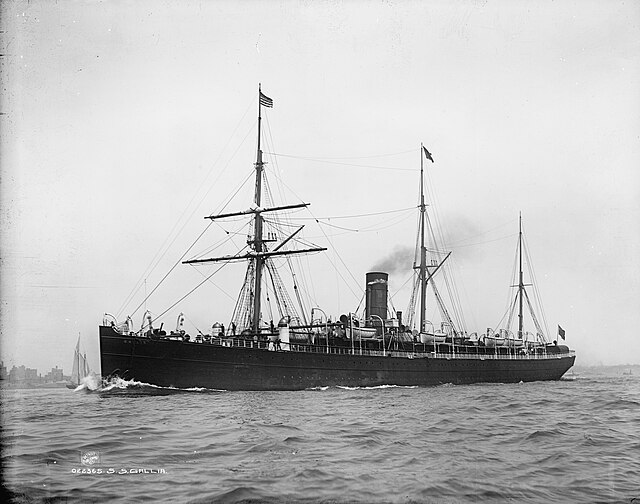
The next twist in this story involved John’s two sons, John and Otley. Together they left Liverpool on 12 November 1881 on the ship Gallia (see following image). On arrival in New York on 25 November 1881, they were described as farmers bound for Canada. While John made a life for himself in Ontario, Canada, Otley returned to Wistow where he married Elizabeth Lacy (1861-1938), on 30 June 1883, in Wistow parish church. Unfortunately, Otley was an unsuccessful farmer and was declared bankrupt in 1895 (York Herald 3 May 1895, p3). Otley was buried in St Peter and St Paul, Drax churchyard on 6 June 1937.
John and Otley’s eldest sister Mary, a widow, emigrated to Canada with her children Ellen (Helen), Louise and John together with Ellen’s husband Edward Bridgeman. They left Liverpool on 11 January 1894 on the ship Mongolian, bound for Halifax, Nova Scotia. It seems likely that Mary’s son Otley Palframan Turner preceded them to Canada, but a passenger list record has so far not been found for him. Mary died on 7 September 1916 in Toronto, Canada and was buried in Mount Pleasant cemetery. York, Ontario. When her brother John died on 26 June 1924 he was buried in Prospect cemetery, another Toronto Trust Cemetery, in a grave owned by his wife Frances Wheeler (1858-1938).

Finally

I would like to know more about the people mentioned in this blog post. Do contact me if you have any further information which you are willing to share with me.

Notes:

The map used in this blog has been reproduced with the permission of the National Library of Scotland under the following creative commons licence https://creativecommons.org/licenses/by-nc-sa/4.0/ and sourced from the NLS maps site https://maps.nls.uk/.

Bibliography:

Births, marriages and deaths. https://www.ancestry.co.uk/ : accessed July 2025.

Canadian Passengers Lists, 1865-1935. https://www.ancestry.co.uk/ : accessed July 2025.

Census records. https://www.ancestry.co.uk/ : accessed July 2025.

England and Wales, National Probate Calendar (Index of Wills and Administrations), 1858-1966. https://www.ancestry.co.uk/ : accessed July 2025.

New York, US, Arriving Passengers & Crew Lists (including Castle Garden & Ellis Island), 1820-1957. https://www.ancestry.co.uk/ : accessed July 2025.

Ontario, Canada ,Deaths and Deaths Overseas, 1869-1947. https://www.ancestry.co.uk/ : accessed July 2025.

Ontario, Canada Marriages, 1735-1985. https://www.ancestry.co.uk/ : accessed July 2025.

Ontario, Canada, Toronto Trust Cemeteries, 1826-1929 https://www.ancestry.co.uk/ : accessed July 2025.

OS Map. https://maps.nls.uk/ : accessed July 2025.

Selby Times. https://www.findmypast.co.uk/ : accessed July 2025.

Ship Gallia. https://commons.wikimedia.org/wiki/Main_Page : accessed July 2025.

UK and Ireland, Find A Grave Index, 1300s to Current. https://www.ancestry.co.uk/ : accessed July 2025.

Yorkshire baptisms, marriages and burials. https://www.findmypast.co.uk/ : accessed July 2025.

York Herald. https://www.findmypast.co.uk/ : accessed July 2025.
Guy Silversides (1883-1964) – emigration to Canada

Introduction

I am continuing my occasional research into more distant members of my family. Currently I am working on a project for the Family and Community History Research Society looking into the experience of patients in County Pauper Lunatic Asylums during the period 1861-1901. While researching my Silversides cousins I came across Guy, my third cousin four times removed, working as an attendant in Stanley Royd Hospital, Wakefield in the 1911 census. Stanley Royd was the first West Riding county pauper lunatic asylum built in 1818. Guy didn’t remain working there long but turned out to be interesting for another reason; he emigrated to Canada not long after the 1911 census was taken.

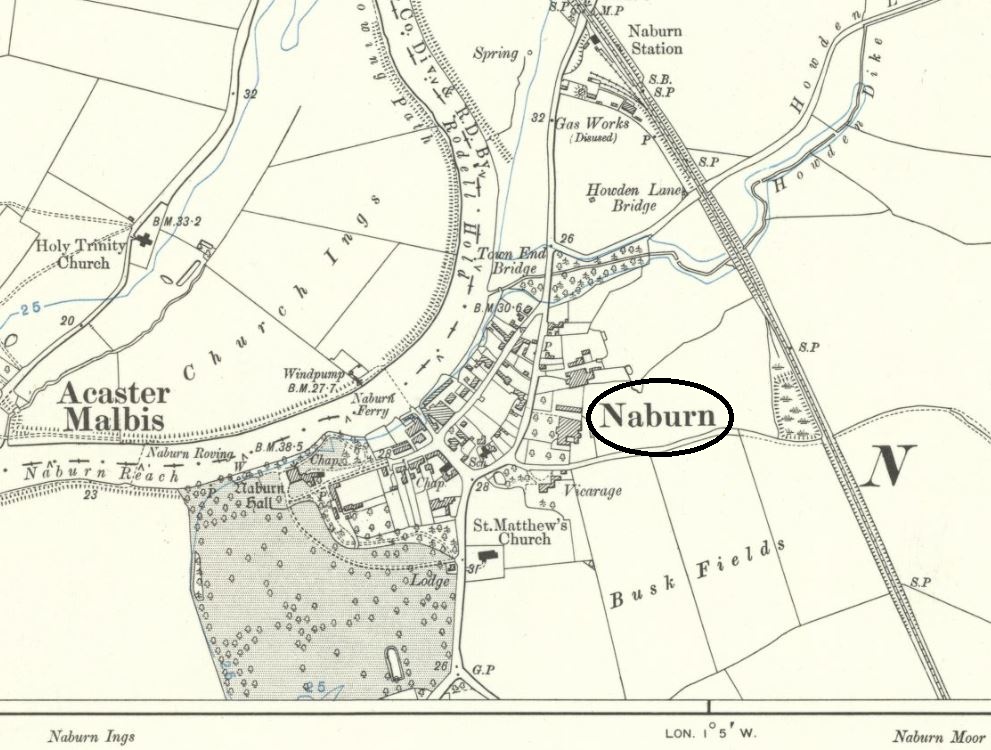
Guy was the youngest son of William Silversides (1842-1916) and Elizabeth Habbishaw (1842-1927). He was born in Naburn near York (see OS Yorkshire sheet CXCI.NW published 1910 map) and was said to be 18 and a gardener when he enlisted in the Northumberland Fusiliers on 27 February 1900. Guy was 5ft 5in tall, weighed 124lbs, with brown hair, blue eyes and a fresh complexion. His three older brothers, George, Robert and John had enlisted in the army before him and two of his sisters’ married men who served in WWI.

Guy’s military record indicated he had served as a bandsman in the West Indies and then South Africa where he arrived on 23 July 1902. The Treaty of Vereeniging, which ended the Second Boer War, had been signed on 31 May 1902. Guy remained in South Africa until 4 March 1907. As a sergeant bandsman he was posted to the army reserve on 7 March 1908. While serving in the army he gained his St John’s ambulance certificate for first aid to the injured. Perhaps this enabled him to gain a position at Stanley Royd as an attendant. Guy was working there when the 1911 census was taken on 2 April. Not long afterwards his military record showed that on 2 June 1911 he was permitted to go to Canada.

Emigration to Canada

Guy left Liverpool for Canada on 7 July 1911 as a passenger on the steamship Victorian, Allan Steamship Line, bound for Montreal, Quebec, Canada. He arrived on 14 July 1911 and was described as an attendant with the intention of farming. His entry on the passenger list was stamped “British Bonus Allowed”. Commission was paid to UK steamship booking agents, by the Canadian government’s Immigration Branch, for suitable immigrants who bought a ticket to sail. Guy as the passenger did not receive a bonus.

The next record found for Guy was his marriage to Edythe M Kimber (or Kember) in 1913 in Edmonton, Alberta. Edythe, a nurse, had left Liverpool on 21 February 1913 bound for New Brunswick, on the Hesperian, Allan Steamship Line.

On 8 January 1915 Guy enlisted in the 101st Canadian Overseas Expeditionary Force Band Corp. He was described as an attendant living at 9725, 96a St, Edmonton South, with his wife Edythe. His previous service with the Northumberland Fusiliers was noted.

Guy departed for England on 8 January 1915 and by 9 October 1915 he was a corporal in the 49th Battalion of the Canadian Infantry on his way to Boulogne, France. While he was serving in the army his personnel records showed that he was granted leave on the following dates:

  • 20 August 1917 – 2 September 1917.
  • 15 February 1918 – 3 March 1918.
  • 25 January 1919 – 8 February 1919.

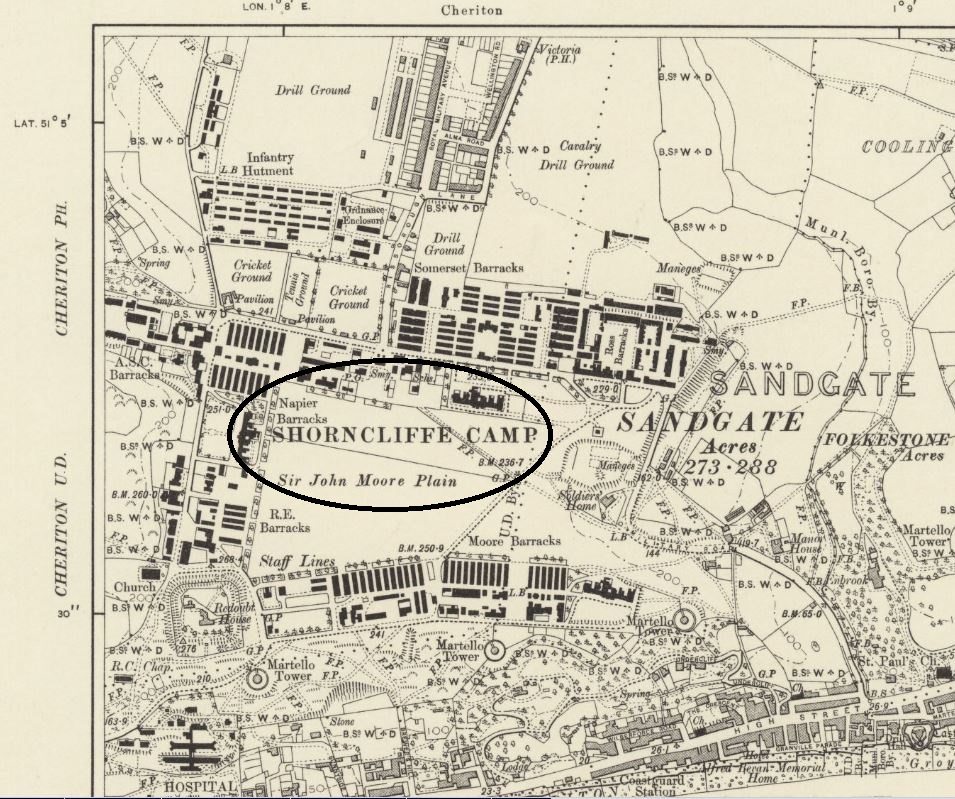
Guy’s personnel record also recorded separation payments to his wife Edythe. She returned to England on 2 August 1915 and gave her intended address as 43 Pentonville Rd, London. The record of her payments showed that she didn’t remain there for the duration of WWI. Edythe spent some time at 2 Darby Terrace, Horn Street, close to Shorncliffe camp used as a base for the Canadian forces (see OS Kent sheet LXXV.SW published 1908map). This was also where Guy’s brother John was base and his wife and family were at 2 Darby Terrace. Edythe’s final address was in Naburn, possibly with other members of Guy’s family. Perhaps he was able to visit her when he returned on leave from France.

After the end of WWI Guy and Edythe both returned to Canada on separate ships. Edythe arrived back at St John’s, New Brunswick on 25 April 1919 on the ship Corsican while Guy returned to Canada on 2 May 1919. After this date no records have been found which included either or both of them, notably the 1921 census. At some point Guy moved to Vancouver where he married his second wife, Elsie Davenport (1902-1970), on 23 May 1931. They were recorded together in the 1931 Canadian census when Guy’s occupation was recorded as a postman, who was not working. It is not clear what happened to his first wife Edythe. They may have divorced and it is possible Edythe remained in Alberta and remarried there in 1924.

Guy and Elsie continued to live in Vancouver where they were recorded on lists of voters:

  • 1945 – Guy, a mail carrier, and Elsie living at 2784 Adanac St, Vancouver East.
  • 1949 – Guy, retired, and Elsie living at 2784 Adanac St, Vancouver East.
  • 1962 – Guy, retired, and Elsie living at 2784 Adanac St, Vancouver East.

Guy died on 12 May 1964 in Vancouver, British Columbia, Canada. His burial record stated that he had been in Canada for 45 years and Vancouver for 41 years. It also included information from his British Columbia marriage record and that he was a bachelor when he married Elsie. His first marriage to Edythe was mentioned and she was his next of kin in his Canadian Expeditionary Force personnel file. If he had been in Vancouver for 41 years then that suggests he moved there about 1921, possibly two years after he returned to Canada from serving in WWI.

Finally

I would like to know more about all the people mentioned in this blog post, and in particular, Guy who emigrated to Canada. Do contact me if you have any further information which you are willing to share.

Note: the maps used in this blog have been reproduced with the permission of the National Library of Scotland under the following creative commons licence https://creativecommons.org/licenses/by-nc-sa/4.0/ and sourced from the NLS maps site https://maps.nls.uk/.

Bibliography:

Alberta, Canada, Marriages Index, 1898-1944. https://www.ancestry.co.uk/ : accessed August 2024.

Births, marriages and deaths. https://www.ancestry.co.uk/ : accessed August 2024.

British Army WWI Medal Rolls Index Cards, 1914-1920. https://www.ancestry.co.uk/ : accessed August 2024.

British Army WWI Service Records, 1914-1920. https://www.ancestry.co.uk/ : accessed August 2024.

British Columbia, Canada, Death Index, 1872-1990.

British Columbia, Canada, Marriage Index, 1872-1935. https://www.ancestry.co.uk/ : accessed August 2024.

Canada, Find a Grave® Index, 1600s-Current. https://www.ancestry.co.uk/ : accessed August 2024.

Canada, Incoming Passenger Lists, 1865-1935. https://www.ancestry.co.uk/ : accessed August 2024.

Canada, Voters Lists, 1935-1980. https://www.ancestry.co.uk/ : accessed August 2024.

Canada, World War I CEF Attestation Papers, 1914-1918. https://www.ancestry.co.uk/ : accessed August 2024.

Canada, World War I CEF Personnel Files, 1914-1918. https://www.ancestry.co.uk/ : accessed August 2024.

Canadian Immigration Records. https://library-archives.canada.ca/eng/collection/research-help/genealogy-family-history/immigration/pages/immigration.aspx : accessed August 2024.

Census records. https://www.ancestry.co.uk/ : accessed August 2024.

Newspapers. https://www.findmypast.co.uk/ : accessed August 2024.

OS Maps. https://maps.nls.uk/ : accessed August 2024.

Passenger Lists Leaving UK 1890-1960. https://www.findmypast.co.uk/ : accessed August 2024.

Shorncliffe Camp. https://www.saltwoodkent.co.uk/the-canadian-at-shorncliffe-during- : accessed August 2024.

UK and Ireland, Incoming Passenger Lists, 1878-1960. https://www.ancestry.co.uk/ : accessed August 2024.

UK and Ireland, Outward Passenger Lists, 1890-1960. https://www.ancestry.co.uk/ : accessed August 2024.

UK, Royal Hospital Chelsea Pensioner Soldier Service Records, 1760-1920. https://www.ancestry.co.uk/ : accessed August 2024.

Yorkshire baptisms, marriages and burials. https://www.findmypast.co.uk/ : accessed August 2024.

Alice Bellinger (1875-1917) – servant at Woburn Abbey

It’s rare that I write about any of my ancestors who lived in an adjoining county to where I live now. When I came across Alice, my 4th cousin twice removed, I decided it was time to see what I could find out about her.

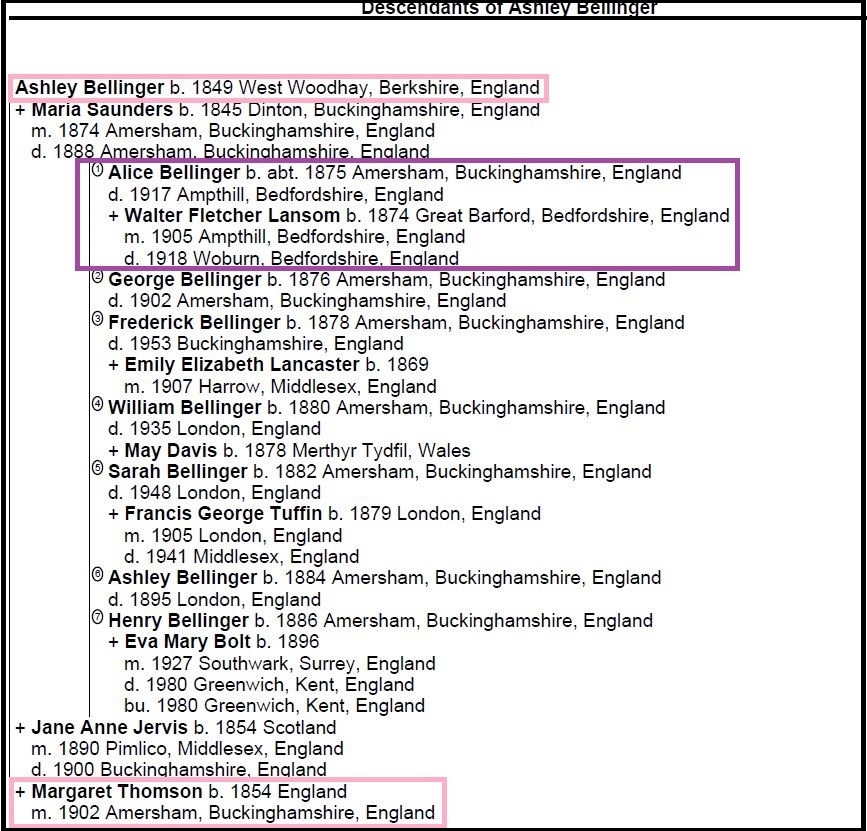
Alice was the eldest daughter of Ashley Bellinger (born 1849) and his first wide Maria Saunders (1845-1888); she was born in Q1 1875 in Amersham, Buckinghamshire and is highlighted in purple on the following outline descendant chart.  

Descendant chart for Ashley Bellinger

Alice’s father Ashley was a gamekeeper and in the 1881 census the family were living in Keepers Cottage, Amersham. In 1910, Ashley and his third wife, Margaret, highlighted in pink on the above chart), emigrated to Canada on the SS Empress of Ireland. They arrived in Quebec on 29 September 1910 and settled in Kelvington, Saskatchewan, Canada where Ashley became a farmer.

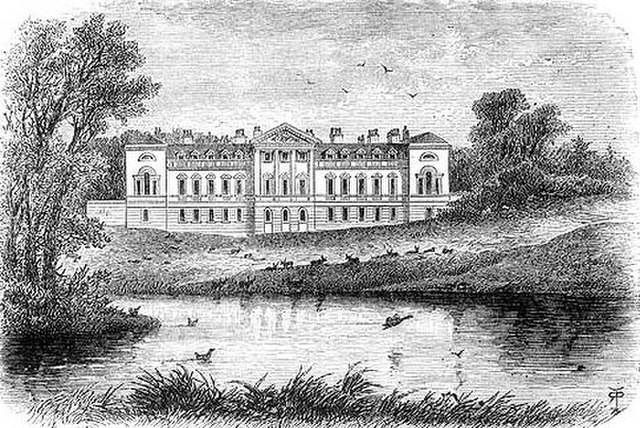
By 1891 Alice had left home and was a kitchen maid working for the Matthews family in Northaw, Hertfordshire. In the 1901 census she was working as a laundry maid at Woburn Abbey, the seat of the Bedford family. There she met her future husband Walter Fletcher Lansom (1874-1918), a stable helper. The following picture is of Woburn Abbey, Bedfordshire:

Woburn Abbey, Bedfordshire from Picturesque England

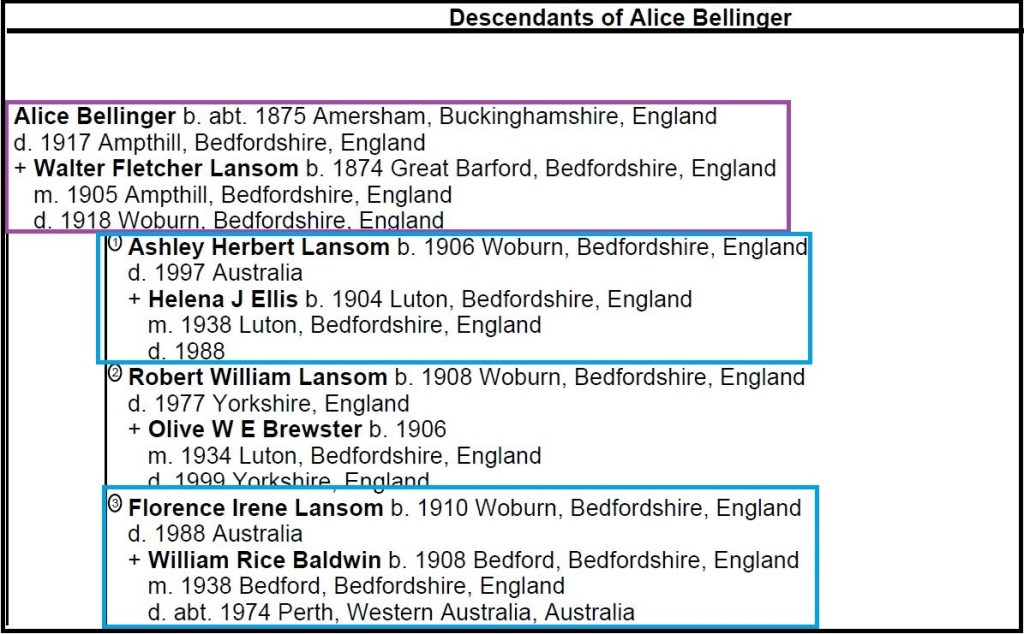
Alice and Walter married in Q4 1905 and settled in Woburn. In 1911 they were living at 39 Bedford Rd with their three children, with Walter working as a “chauffeur domestic” (see the following outline descendant report for Alice).

Descendant chart for Alice Bellinger

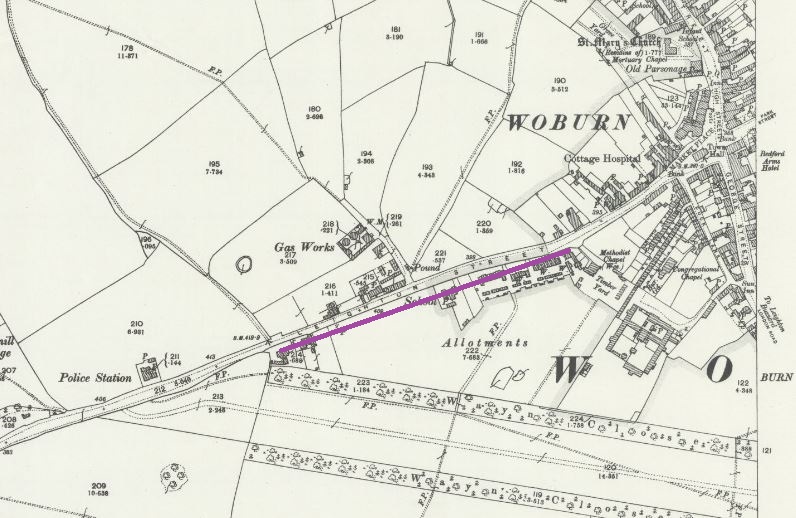
Alice died in 1917, and Walter on 13 February 1918, leaving their three young children orphans.  A memorial entry in the Bedfordshire Times and Independent (13 February 1920), posted by Walter’s sister Renee, gave further information about Walter’s death. He was said to have “passed peacefully away at 62, Leighton Street, Woburn, Beds., on February 13th 1918, aged 44 years.” The following 1901 OS map for Woburn has been annotated to show the location of Leighton Street.

OS Bedfordshire Sheet XXIV.7 date 1901

The recently released 1921 census shed further light on what happened to Alice and Walter’s three children after Walter’s death. Their eldest son Ashley Herbert Lansom (1906-1997) and daughter Florence Irene Lansom (1910-1988) were recorded living with Alice’s older brother Frederick Bellinger and his wife in Walthamstow, Essex. Frederick was a plumber and Ashley, aged 15yrs 1month, a page boy working for bankers Guaranty First Co. of New York, 31 Lombard Street, London EC2. His sister was at school. Their brother, Robert William Lansom (1908-1977) aged 12yrs 10months, was found in the Royal Albert Orphanage, Camberley, Surrey where the census records that his parents were both dead and that he was at school.  Robert married and in 1939 was living in Letchworth, Hertfordshire.

In 1949, Ashley and his family emigrated to Australia. They arrived in Freemantle, Western Australia on 15 November 1949 on the SS Otranto. The Perth Sunday Times reported, on 13 November, that the Otranto was one of three ships bringing a total of 364 migrants to Australia.

Ashley and his family settled near Perth where he worked as a plumber. Ashley’s sister, Florence Irene, also emigrated with her husband William Rice Baldwin (1908-1974) to Australia. They arrived in Freemantle on the SS New Australia on 2 March 1952 with their intended address being that of her brother Ashley: 105 Rupert St, Subiaco, Perth.

I am interested in knowing more about all the people mentioned in this blog post, and in particular, what happened to Ashley and his family in Australia. Do contact me if you have any further information which you are willing to share with me.

Note: the map used in this blog has been reproduced with the permission of the National Library of Scotland under the following creative commons licence https://creativecommons.org/licenses/by-nc-sa/4.0/ and sourced from the NLS maps site https://maps.nls.uk/.

Bibliography

1939 Register. https://www.ancestry.co.uk/  : accessed January 2022.

Australia, Electoral Rolls, 1903-1980. https://www.ancestry.co.uk/  : accessed January 2022

Bedfordshire Times and Independent. https://findmypast.co.uk : accessed January 2022.

Births, marriages and deaths. https://www.ancestry.co.uk/  : accessed January 2022.

Canadian Census Records. https://www.ancestry.co.uk/  : accessed January 2022.

Canadian Passenger Lists, 1865-1935. https://www.ancestry.co.uk/  : accessed January 2022.

Census Records. https://www.ancestry.co.uk/  : accessed January 2022.

Freemantle, Western Australia Passenger Lists, 1897-1963. https://www.ancestry.co.uk/  : accessed January 2022

OS Maps. https://maps.nls.uk/ : accessed January 2022.

Trove. https://trove.nla.gov.au/newspaper/ : accessed January 2022.

Woburn Abbey. https://commons.wikimedia.org/wiki/Main_Page : accessed January 2022.