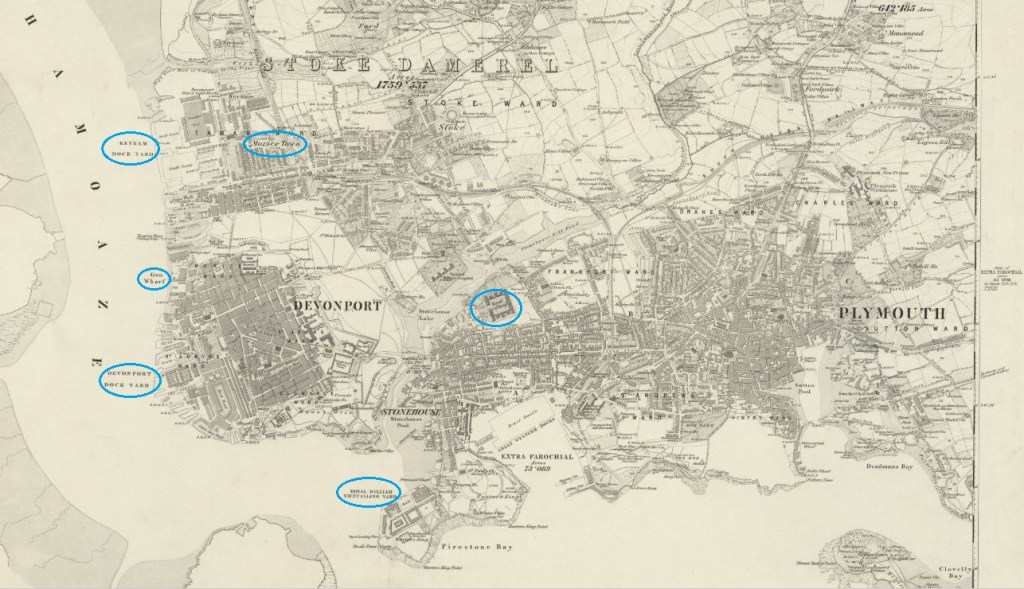
Joseph is linked to my Ellis ancestors through his sister Elizabeth Small Burt (1812-1894) and her husband George Brown (1811-1897), who are my three times great grandparents. Their daughter Elizabeth Small Brown (1844-1916) married my two times great grandfather Francis Ellis (1839-1925) in Portsea, Hampshire, where he was serving in the Coastguard service. The following OS map has been annotated with a number of locations where George and Elizabeth lived with their family in the 19th century.
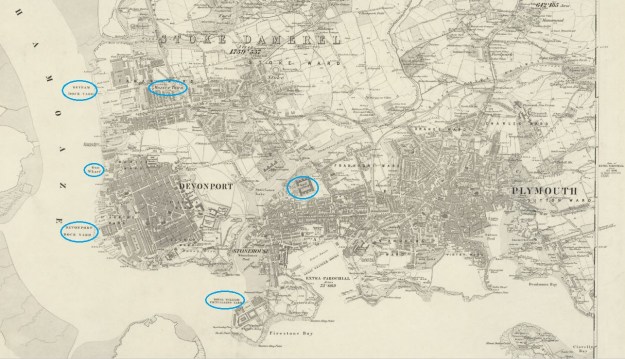
Joseph, according to his naval record, was born on 14 January 1828 in Torpoint, Cornwall to parents Jacob Burt (1781-1873) and Elizabeth Small (1782-1845). In the 1841 census the family are living in Antony in Cornwall and Jacob is a ropemaker. At the age of 22 Joseph joined the navy on 23 October 1849 and was described as a cooper. This was just over a year after he had married his wife Emma Betty in Q2 1848 in East Stonehouse, Devon. Their daughter Emma Jane Burt (1848-1925) was born not long after in Devonport.
Joseph’s naval service record paints a picture of his physical features. He was 5ft 5in tall with light brown hair, a fair complexion and light hazel eyes with no distinguishing marks. It also gives an interesting insight into his career in the Royal Navy. From 23 October 1849 until 4 June 1852, Joseph served on HMS Conflict, a wooden sloop, based in south east America until it returned to Portsmouth. He then served on HMS Hogue, an unarmoured wooden screw vessel, from 1 September 1852 until 23 May 1856. Initially it was a guard ship in Devonport, before it went to the Baltic in 1854 during the Russian war. It was reported in the Times of 6 March 1854 that it was one of several ships which had been victualled at Spithead (near Portsmouth) for six months foreign service.
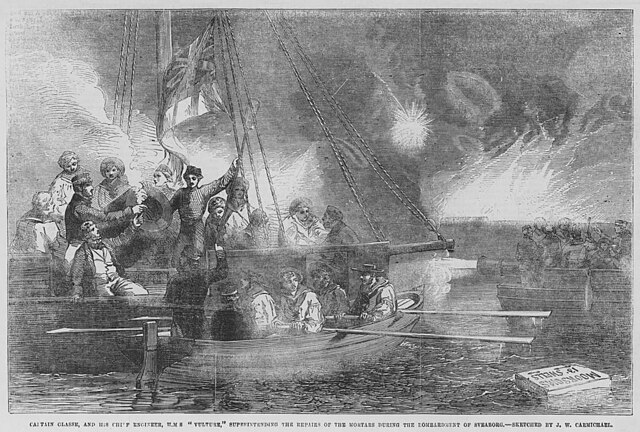
On 24 May 1856 Joseph joined HMS Vulture. It was damaged at the Bombardment of Sveaborg and the illustration is a sketch by James Wilson Carmichael of Captain Glasse and his Chief Engineer supervising its repairs. While Joseph served on HMS Vulture it saw service in the Mediterranean and frequently spent time in Malta and Gibraltar, as well as places like Serpents’ Island in the Black Sea, Sevastopol and then the Bosphorus. The last three places were reported by an officer on HMS Vulture in a letter reproduced in the Glasgow Courier, 27 November 1856, p4.
When HMS Vulture returned to Spithead in 1860 it was inspected and then steamed into Portsmouth. Joseph would have been one of the crew who subsequently boarded the Pigmy steamer bound for Devonport and the chance to be reunited with his family (report in the Naval and Military Gazette and Weekly Chronicle of the Service, 7 April 1860, p3.)
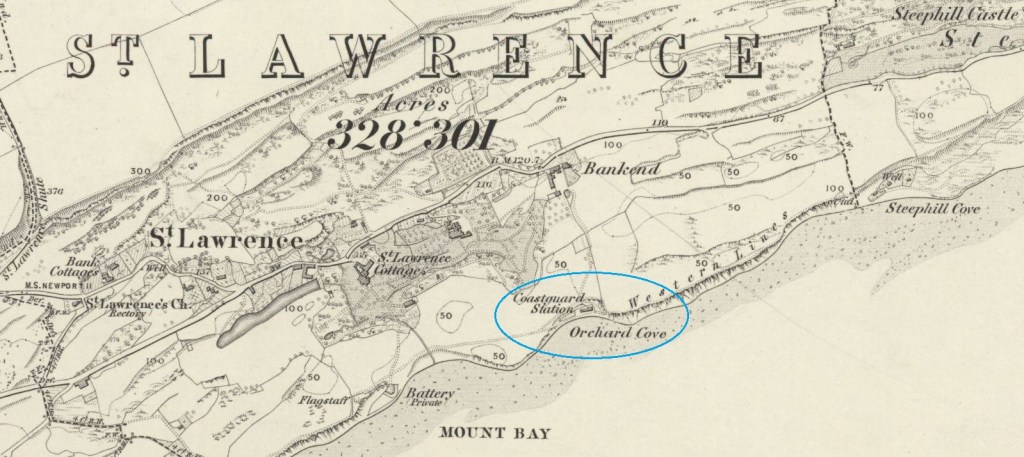
Joseph’s last ship, before he joined the coastguard service, was HMS Impregnable, from 6 April 1860 to 22 May 1860. His first posting as a coastguard was as a boatman and in 1861, he is living with his wife and daughter in Victoria Terrace, Ventnor and described as a coastguard and retired cooper. The coastguard station was to the west of Ventnor as shown on the following OS map (Hampshire and Isle of Wight Sheet C, published 1866). It no longer exists.
Joseph’s record of his coastguard service updates his physical appearance. He is still 5ft 5in tall and with a fair complexion. However, his hair is now described as brown and his eyes grey and he has scars on his right knee and right elbow. On 27 April 1868, while still at Ventnor coastguard station, Joseph was promoted to commissioned boatman; a position he held until 30 April 1873. He was appointed chief boatman on 1 May 1873 and on 6 May 1873 he moved to the coastguard station at Ryde.
Joseph moved back to Ventnor coastguard station on 16 June 1874 was promoted to chief boatman in charge on 7 June 1877. His next move, as chief boatman in charge, was to Crowlink, Sussex on 20 June 1877. He stayed there a couple of years before moving to Cuckmere Haven, Sussex on 5 October 1879.
Joseph was granted a pension on 19 December 1882 and by the 1891 census had returned to the Isle of Wight, where he lived at Bettesworth Rd, Ryde until he died on 5 July 1913. He left effects to the value of £359 1s 7d to his widow Emma. Emma (1826-1915) died at the age of 88 on 15 December 1915. She left effects to the value of £192 15s 6d to her daughter Emma Jane.
Do let me know if you have any stories about them which you are willing to share with me.
Note: the maps used in this blog has been reproduced with the permission of the National Library of Scotland under the following creative commons licence https://creativecommons.org/licenses/by-nc-sa/4.0/ and sourced from the NLS maps site https://maps.nls.uk/.
Bibliography:
Births, marriages and deaths. https://www.ancestry.co.uk/ : accessed February 2025.
Bombardment of Sveaborg. https://www.rmg.co.uk/collections/objects/rmgc-object-12128 : accessed February 2025.
Carmichael, James Wilson. Captain Glasse, and his Chief Engineer, H.M.S. “Vulture,” superintending the Repairs of the Mortars during the Bombardment of Sveaborg. Illustration for The Illustrated London News, 5 April 1856. James Wilson Carmichael, Public domain, via Wikimedia Commons.
Census records. https://www.ancestry.co.uk/ : accessed February 2025.
England and Wales, Non-Conformist and Non-Parochial Registers. https://www.ancestry.co.uk/ : accessed February 2025.
Glasgow Courier. https://www.findmypast.co.uk/home : accessed February 2025.
Naval and Military Gazette and Weekly Chronicle of the Service. https://www.findmypast.co.uk/home : accessed February 2025.
OS Maps. https://maps.nls.uk/ : accessed February 2025.
Probate records. https://www.ancestry.co.uk/ : accessed February 2025.
Victorian Royal Navy. https://www.pdavis.nl/index.htm : accessed February 2025.
UK, Royal Naval Seamen Index, 1853 -1872. https://www.ancestry.co.uk/ : accessed February 2025.
UK, Royal Navy Registers of Seamen’s Services, 1848-1939. https://www.ancestry.co.uk/ : accessed February 2025.
 Joan Reid Genealogy