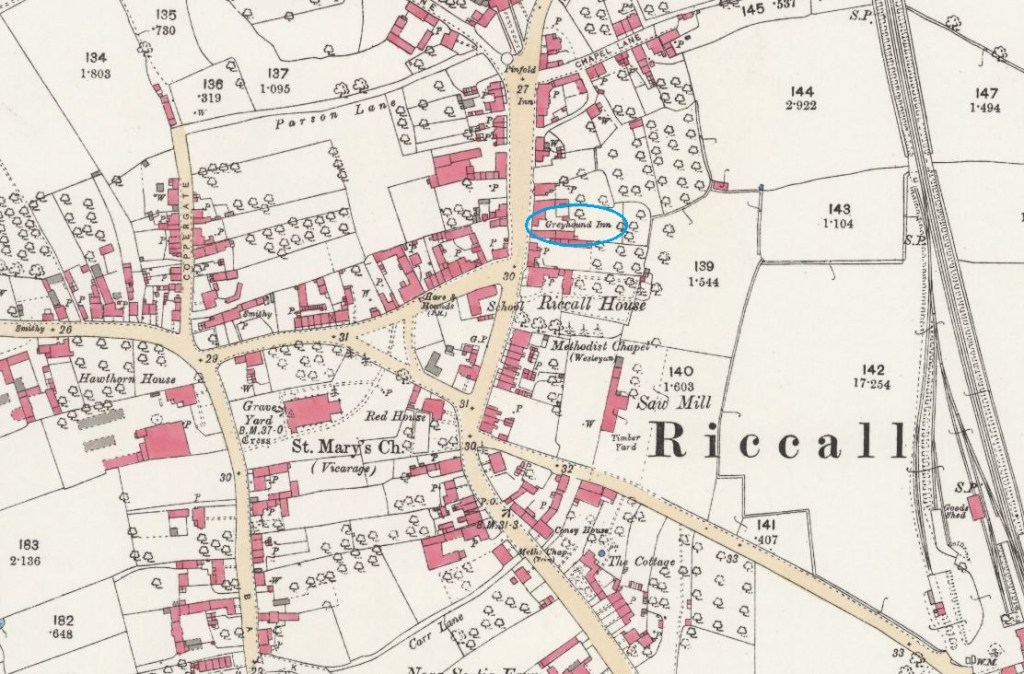
Guy Silversides (1784-1861), the publican at the Greyhound Inn in Riccall, was convicted on 2 March 1824 at the East Riding of Yorkshire Quarter Sessions. His offence, ‘against the conditions of recognizance for the license of an ale house’, resulted in a fine of one guinea with costs of 10 shillings and two pence. The following map shows the location of the Greyhound Inn in Riccall (Ordnance Survey Yorkshire CCVI.II date 1891).
The record from the Quarter Sessions (QSF/463/F/1) provided an insight into the case. A key witness was John Harper junior, an apprentice to Guy. (Guy was also a shoemaker.) John reported that on the evening of the offence, 20 January 1824, four people had played cards in the inn for money. They were his master Guy Silversides, Varley of Cawood, Edward Hawkins, Dowson and Jonathan Romans of Riccall. John saw Jonathan Romans cheating. He suggested that the house was a meeting place for prostitutes and used for gaming. It seems that his master, Guy, had entered his room the following morning, between 5 and 6 am, and ‘struck me twice upon the head’.
Guy, in his defence, asked that the magistrates consider that this was his first offence. It seems that a fellow card player, Jonathan Romans (1791-1858,) had previously been convicted at the Quarter Sessions for using dogs to destroy game in the nearby village of Escrick. His conviction on 17 February 1824 had resulted in a fine of £20 (QSF/463/F/20). Jonathan was described as a farmer from Riccall. A key witness in his trial was the Escrick gamekeeper John Smith. Other witnesses were George Kirk a labourer from Riccall, John Harper of Riccall and Susanna Wellman, a servant of Guy Silversides. Jonathan remained unmarried until his death in the Selby Union Workhouse on 31 January 1858. He was aged 68 and his cause of death was recorded as ‘decay’.
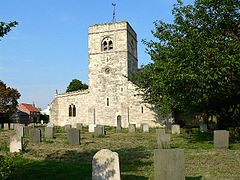
Returning to Guy, my 4th great grandfather; together with his wife Mary Tomlinson (1796-1866), the couple had twelve children. It isn’t clear when Guy gave up the Greyhound Inn. However, in White’s 1840 directory, Guy was recorded as a shoemaker and not the publican at the Greyhound Inn. He continued as a shoemaker in Riccall until at least the 1861 census. Guy died on 11 July 1861 and was buried in St Mary’s Churchyard, Riccall on 14 July 1861.
Finally:
I would like to know more about the people mentioned in this blog post. Do contact me if you have any further information which you are willing to share.
Quarter Session Records: QSF/463/F/1 and QSF/463/F/20. East Riding Archives.
White, William. (1840) History, Gazetteer and Directory of the East and North Ridings of Yorkshire. Sheffield: Robert Leader. pp. 334-5. https://www.ancestry.co.uk/ : accessed June 2025.
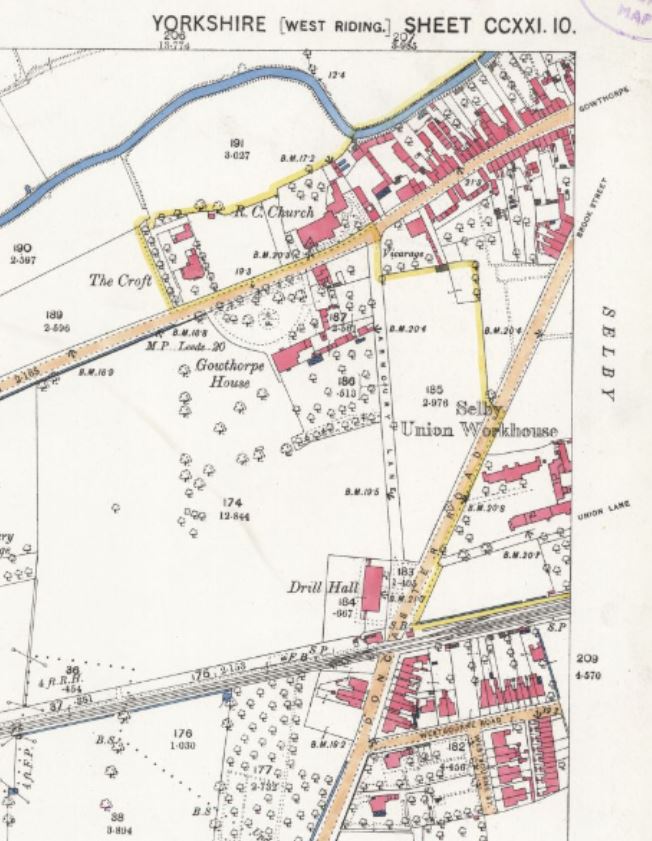
Newspaper reports of crime is something I’ve been looking into recently to develop some presentational material and as part of the research I carry out as a volunteer for my local museum. I am lucky to have some unusual surnames in my paternal ancestry and a newspaper report with the heading “A Fracas at a Wedding” recently caught my eye. The case was held at the Escrick petty sessions and concerned seven defendants who were summoned to the court for causing damage to the door of a man called John Silversides (1824-1890), my first cousin six times removed. (The following map shows the location of the R C church where the wedding took place.)
It seems that John’s daughter Jane (1857-1935), had married Patrick Murray (born 1859) on 12 May 1877, the day of the incident, in St Mary’s Roman Catholic chapel in nearby Selby and gone back to her father’s house in Riccall for a party. The defendants were:
Labourers – Henry Leach Cass, Charles Hare, George Marsden, Joseph Whitehead, William Wood and John Terry.
Fisherman – Thomas Kirk.
They were all summoned for damaging a door at the Silversides house and in addition the first three in the above list were said to have assaulted Jane and the last four for assaulting Patrick. The fracas seems to have occurred after Joseph Whitehead’s wife called at the house sometime between 10 and 11pm and Jane refused to let her stay in the house. There was then a quarrel between the two women, a crowd gathered and Jane returned inside. All seven defendants then broke the door down and Jane’s father john, who was said to be drunk, was then knocked down. Jane and Patrick armed themselves with a poker and tongs to rescue John and the paper then reports that “a regular melee ensued”. It seems that the witnesses called for both sides gave conflicting accounts and the summonses for assault were dismissed by the bench. All seven defendants were fined 5 shillings and costs for the damage to the door.
After their marriage Patrick appeared in more newspaper reports of the Selby Petty Sessions. In the Selby Times 28 February 1878 he was fined 10 shillings and 24 shillings costs for assaulting Ann Cox and in the same newspaper 1 October 1880 he and Terence Rush were bound over to keep the peace for six months for fighting on the highway. They were each fined £5 with costs.
Patrick was not with his wife Jane and their nine-month-old daughter Mary in the 1881 census. They were with Jane’s parents in Coppergate, Riccall. Jane and Patrick then seemed to have moved to Hull where they had two more children. By the 1891 census Jane is back in Riccall, living with Walter Thomas Kirk as his wife in Church St, together with her mother and two surviving children from her marriage with Patrick. So far, I haven’t found a marriage for Jane and Walter. She certainly used the surname Kirk; it was Jane Kirk, sister, who reported the death of her brother Guy in 1920.
I am still trying to trace what happened to Patrick Murray. It looks like he might have returned to work in Hull as a dock labourer. If this is the correct person then he seems to have continued his criminal ways. The 5 July 1920 edition of the Hull Daily Mail relates the case of Patrick Murray, living at 95 Hodgson St, who had 67 previous convictions. If you have any stories about the family which you are willing to share with me then do get in touch.
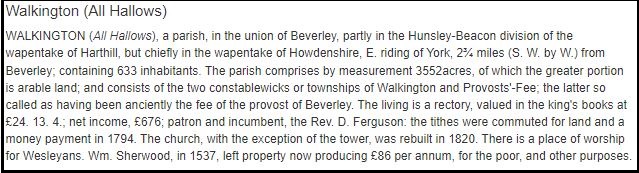
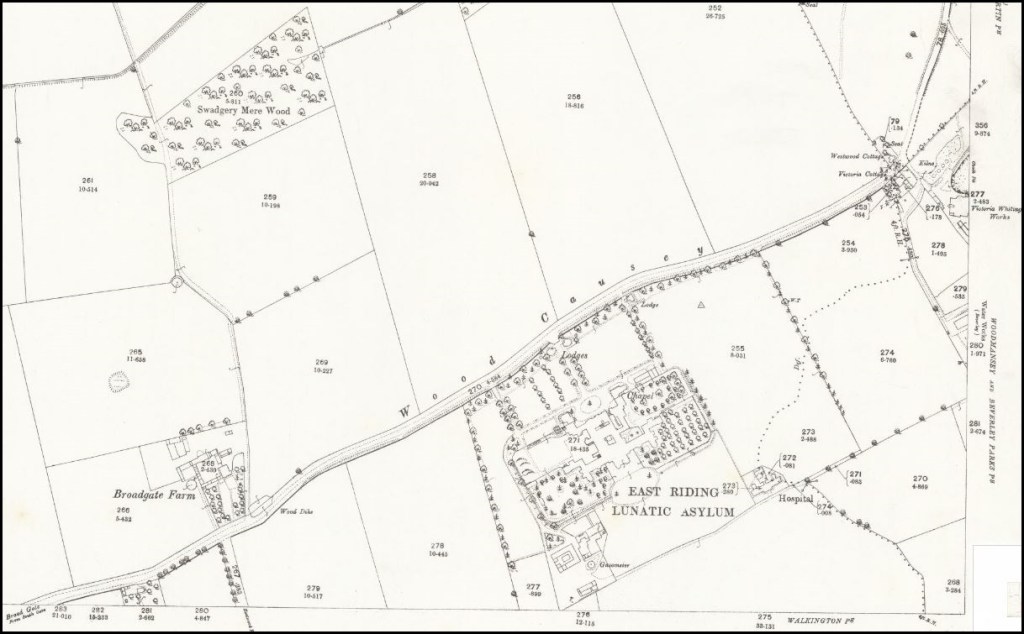
Whilst visiting the East Riding archives at Beverley, I carried out a search of the East Riding of Yorkshire County pauper lunatic asylum case books (NH6/64/20) to see if there were any records for any of my ancestors who might have been admitted to it. The asylum was called Broadgate Hospital and located in Walkington near Beverley. The land it was built on was part of Broadgate farm; it was opened on 25 October 1871 and has since been demolished. Walkington was described by Lewis in 1848 as follows:
The following OS Yorkshire CCX.II map, dated 1893, shows the location of the asylum to the north east of the village of Walkington, just off the B1230 road.
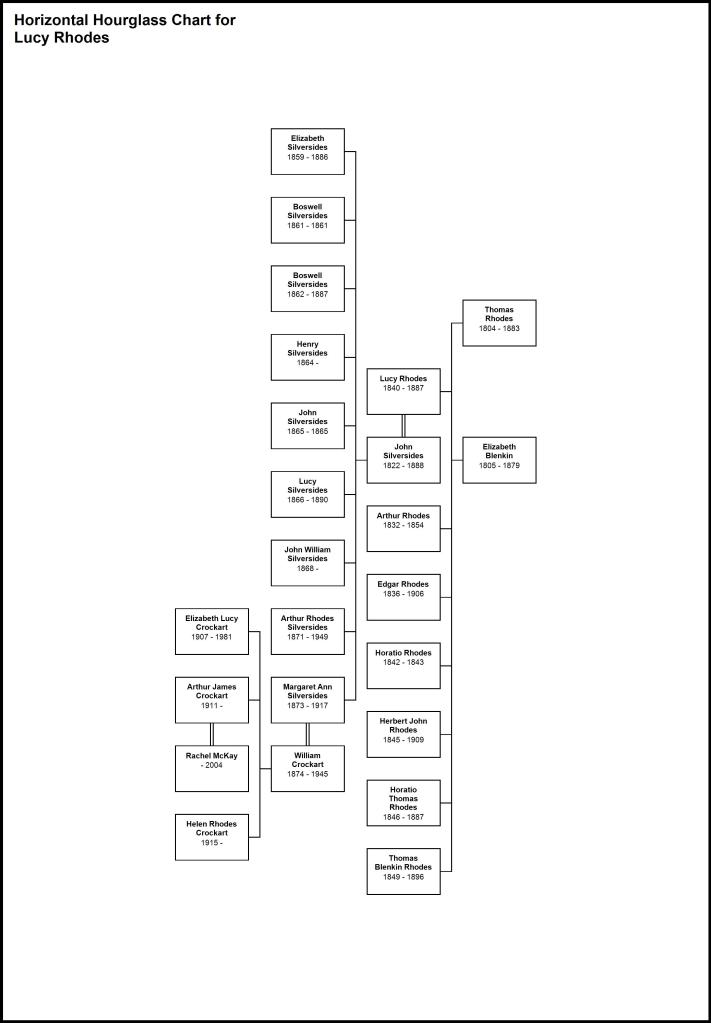
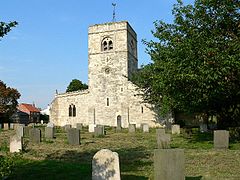
The East Riding archives hold a series of case books for Broadgate hospital and my ancestor Lucy Silversides featured in the women’s case book number 5. Lucy was the wife of John Silversides (1822-1888), my second cousin five times removed. She was born Lucy Rhodes in 1840 in Patrington, Yorkshire to parents Thomas Rhodes (1804-1883) and Elizabeth Blenkin (1805-1879). By the time Lucy’s brother Arthur died in 1854, the family were living in Osgodby, a few miles from Riccall where John Silversides lived. Lucy married John in St Mary’s church, Riccall on 11 November 1858; Lucy was 18 and John 36.
In the 1861 census John, Lucy and their daughter Elizabeth (1859-1886) were living in Riccall where John was described as a farmer of 100 acres employing two labourers. John and Lucy had nine children: six boys and three girls. Two of their sons died in infancy, three children in their twenties, two sons have been difficult to trace and just one of their children definitely married: Margaret Ann Silversides (1873-1917). In 1891 their son Arthur Rhodes Silversides (1871-1949) was a footman at The Villa in Escrick; a property where I once owned an apartment. By 1901 he had become a butler; when he died on 11 January 1949 in York, he left effects to the value of £1,784 8s 9d. The following chart shows John, Lucy and their family.
Arthur’s mother Lucy faired rather differently. By the 1881 census John, Lucy and six of their children (Elizabeth, Boswell, Henry, John, Arthur and Margaret) were living in Dam End in Riccall. Their daughter Lucy was living with her aunt and uncle. By now John was aged 59 and described as an agricultural labourer, as were their sons Boswell and Henry. Boswell and Henry were recorded as joining the police in Leeds in 1885. Daughter Elizabeth died in 1886 and sons John and Arthur and daughter Margaret were elsewhere in 1891. Perhaps by the time Lucy was admitted to the Broadgate hospital in 1887 she had been affected by significant changes in her family life.
Lucy was admitted to Broadgate from the Selby Union on 1 March 1887. The case book mentioned that her first mental health attack had lasted for eight months. It is interesting to note that she entered the asylum from the Selby Union. She was described as being aged 50, married and her religion was Church of England. With regards to her mental health, she was of a nervous temperament, dangerous and with her form of insanity described as mania. She was said to be excited and “the patient talks to herself”.
Her physical condition was described as tall, poorly nourished and dirty. The case book then goes onto outline her mental and physical state after her admission. On 4 March “her conversation was silly and voluble”. By 11 March Lucy was “physically in a very bad state and appears to be getting weaker daily…she is nervous and excited and most difficult to manage in short nothing can be done with her…she won’t eat.” It went onto say that “the diet for the most part consists of butter, eggs milk mixture with brandy”. Lucy had diarrhoea.
Lucy died on 13 March 1887 at 8.50pm in the presence of nurse Phebe Allan. Her cause of death was Phthisis. An autopsy was carried out and the record certified by the asylum Medical Superintendent Dr Murdoch Donald McLeod. After her death Lucy was buried in St Mary’s churchyard, Riccall. Her husband John died just over a year later on 16 March 1888. He too was buried in the churchyard. After his death the cottage he was living and his household furniture were sold at auction by Thomas Walker Auctioneers, according to the York Herald dated 14 April 1888. Perhaps by then none of his children were around to take an interest in his furniture.
So far, I’ve been unable to trace what happened to two of John and Lucy’s sons: Henry Silversides (born 1864) and John William Silversides (born 1868). Do let me know if you have any stories about the family which you are willing to share with me.
During a recent visit to the East Riding of Yorkshire archives at Beverley, I decided to review a number of documents I’d identified in their online catalogue which I thought might be relevant to my own family history.
I came across a bastardy order (QSU1/40/50 ) dated 1 July 1839 which named William Rooke as the putative father of a female child born to Mother Hannah Silversides. The Selby Guardians of the Poor had an interest in bringing the case as the child had been born in the parish of Riccall and as such the child was chargeable to the parish.
William Rooke was ordered to pay a sum, not exceeding one shilling per week, to the overseers of the poor of the parish of Riccall, for maintenance of the child. The order included the requirement that the sum should be paid until the child attained the age of 7 years.
I decided to find out more about Hannah to see if she was related to the Silversides in my family tree and thus to myself. My research revealed that Hannah, whose maiden name was Mitchel, was the second wife of Robert Silversides (1768-1829), my 5th great grand uncle. Robert and Hannah were married in St Mary’s Church, Riccall on 27th September 1821 by banns. Robert was described as a farmer and widower and Hannah a spinster. Robert signed the marriage record but Hannah signed using her mark. One of the witnesses was Guy Silversides, Robert’s brother, although quite a few male members of the family have the first name Guy.
Robert and Hannah had a son John baptised in the same church on 11 July 1824. Just five years later, Robert was buried in St Mary’s churchyard on 20 February 1829 when he was described as a labourer. With his first wife Sarah Riley (1772-1815) he had had at least seven children, four boys and three girls. Perhaps his fortunes had changed and Hannah experienced difficulties after his death. It looks like her son John was working in Bossall in the North Riding of Yorkshire when he married his wife Jane Wilson on 17 February 1845.
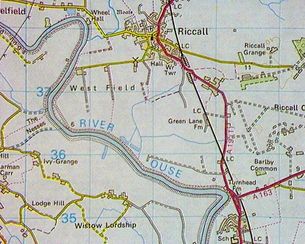
Returning now though to William Rooke and the bastardy notice. It does seem that he may well have been the father of Hannah’s second child Ann Silversides who was baptised on 24 November 1839 in St Mary’s Church, Riccall. Her baptism records her as the illegitimate child of Hannah Silversides, widow. Both Hannah and Ann were recorded in the 1841 census in Wheel Hall, Riccall with Hannah described as a labourer. Wheel Hall was originally a manor house but was replaced in the 18th century by a farmhouse.
Hannah died in 1845 and was buried in St Mary’s Churchyard on 5 May 1845. What happened to her daughter Ann is not clear, nor is the identity of her father. There was a William Rooke recorded in the 1841 census at Riccall Hall who was an agricultural labourer born about 1816. No further information on him in Riccall has been found. If you any information on either of Ann Silversides or William Rooke do, please contact me.
While researching my family history I have come across a number of unusual surnames and this blog post is the second in a series I plan to write about them. I’ve chosen Silversides for this post, in part because it is an interesting surname, and also because it leads to one of my many brick walls.
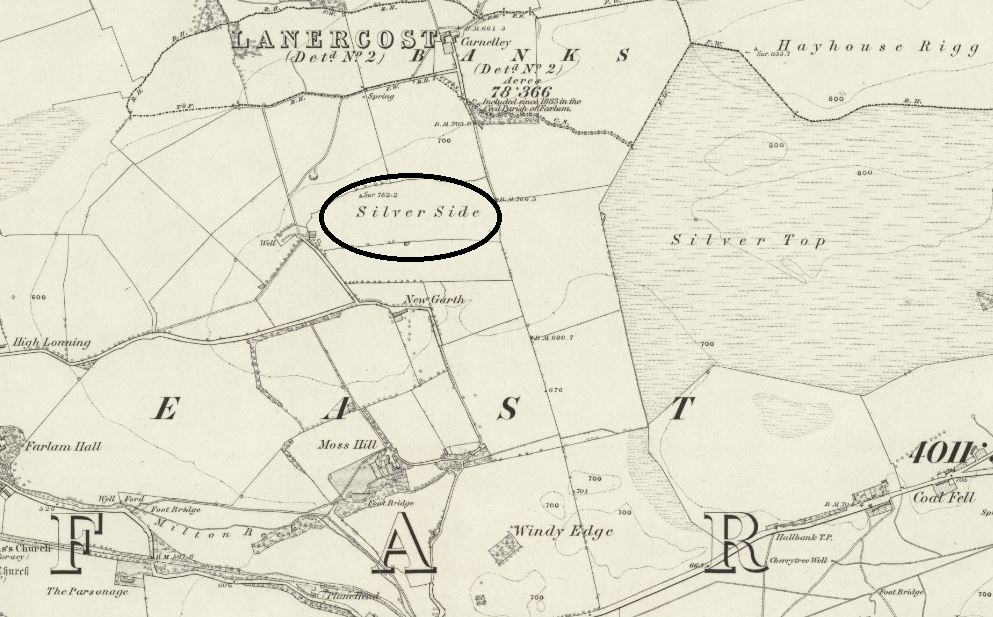
Origin of surname – according to the Oxford Dictionary of Family Names in Britain and Ireland, Silversides has two possible derivations. Firstly, it’s the plural of Silverside, thought to be a nickname from Middle English: silver plus side (of the body or head). Other names to compare it with are Siluermouth (silver mouth) and Silvertop (silver hair). An alternative is that it is a locative name from Silver Side in Farlam in Cumbria which was recorded in 1485. The following OS Cumberland XVIII map dated 1868 shows its location:
In the case of my own ancestors, I think it’s more likely that their surname, Silversides, is the plural of Silverside, a nickname from Middle English. The majority of family members I’ve found come from the East and West Ridings of Yorkshire. 209 Silversides were recorded in Great Britain in 1881.
My ancestral connections – William Silversides (1690-1756) is my seven times great grandfather on the Sarginson/Foster side of my family. According to an entry in FindaGrave he was baptised on 5 March 1690/91 in Nun Monkton, West Riding of Yorkshire and his father was named as William. Nun Monkton is 8 miles Northwest of York and 12 miles from Escrick in the East Riding of Yorkshire. Escrick where William married his wife Mary Brown (1691-1780) on 25 November 1725.
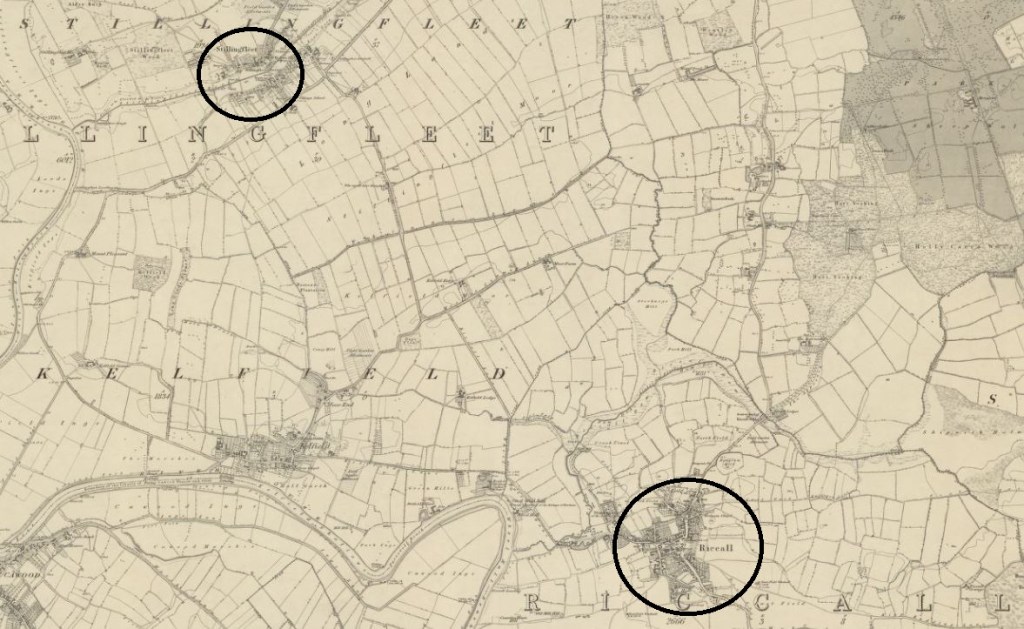
William and Mary had at least six children, five sons and one daughter. Their two eldest sons were born in Stillingfleet and the family then moved to Riccall. The following OS Yorkshire 206 map dated 1851 shows the villages of Stillingfleet and Riccall:
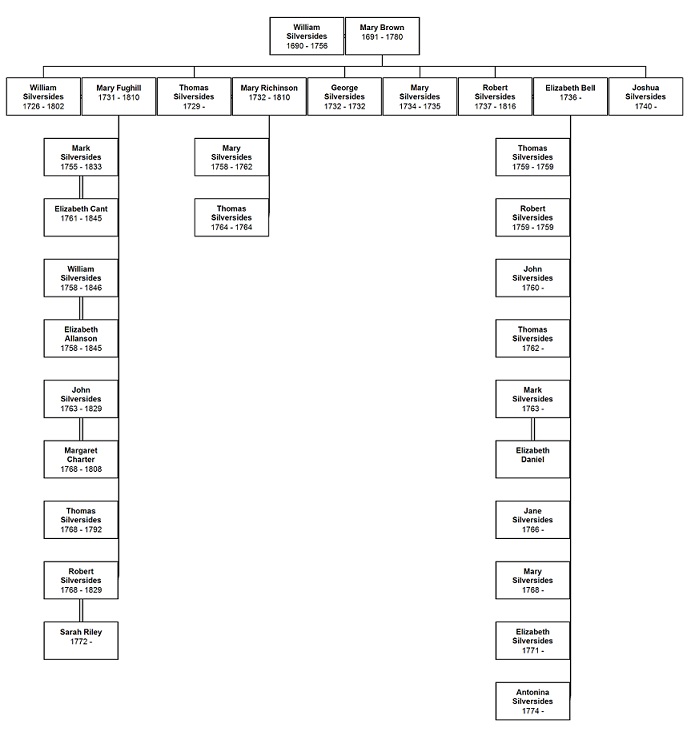
Some of the children’s baptism records give their father’s occupation as a labourer, most likely an agricultural labourer, as Escrick, Stillingfleet and Riccall are all villages within a few miles of each other in the Vale of York known for its agriculture. The following descendant chart shows William and Mary and two generations of their descendants:
The family settled in Riccall. William was buried in St Mary’s Churchyard on 20 June 1756 and his wife Mary on 23 August 1780 when she was described as a widow aged 89 who had died of a fever.
William and Mary’s son William (1726-1802) was my six times great grandfather. He married Mary Fughill (1731-1810) and they had at least five sons. When William died his burial record gave his age as 77 and that he had been a farmer who had died of natural decay. So far, I haven’t found any land tax records for him to indicate from whom he leased land.
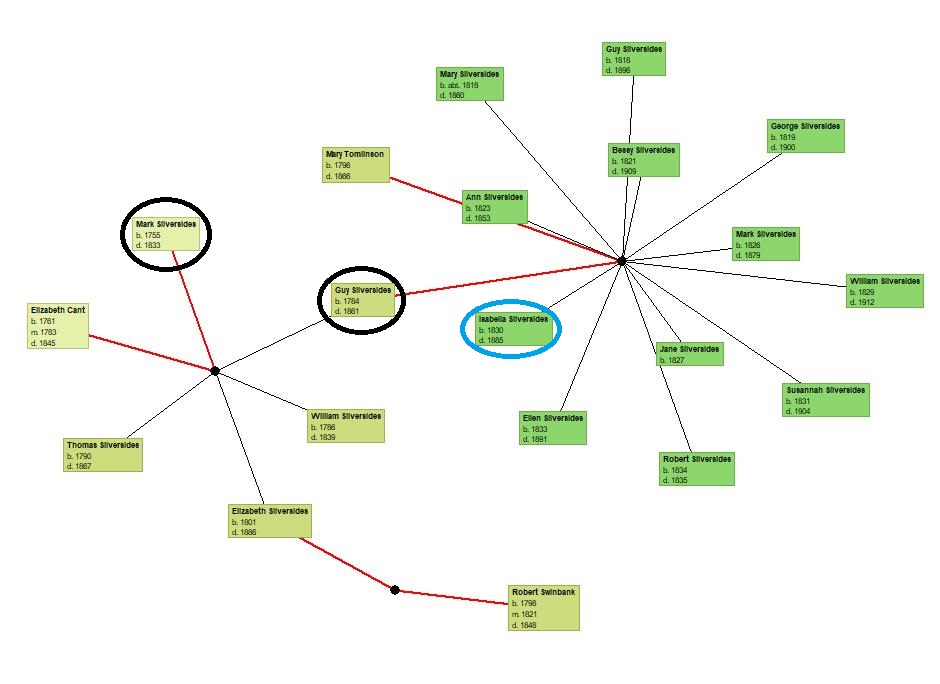
Mark Silversides (1755-1833) my five times great grandfather – Mark was William and Mary Fughill’s eldest son. He was baptised on 13 May 1755 in St Mary’s Church, Riccall and he married Elizabeth Cant (1761-1845) on 2 December 1783 in the same church. They had four sons and a daughter and the following dandelion chart shows Mark, Elizabeth and two generations of their descendants:
Mark and Elizabeth’s eldest son Guy (1784-1861) is my four times great grandfather. He married Mary Tomlinson (1796-1866) in St Mary’s Church on 13 March 1817 and together they had 12 children, five boys and seven daughters.
By 1822 Mark was the licensed victualler at the Greyhound Inn in Riccall according to the 1822 edition of Baines’ History and Directory of the North and East Ridings of Yorkshire. The pub was one of four in Riccall at that time and survives to this day. Baines also helpfully gave the population of Riccall as 599 and that Mark and Robert Silversides, Guy’s father and uncle, were farmers and yeomen in the village.
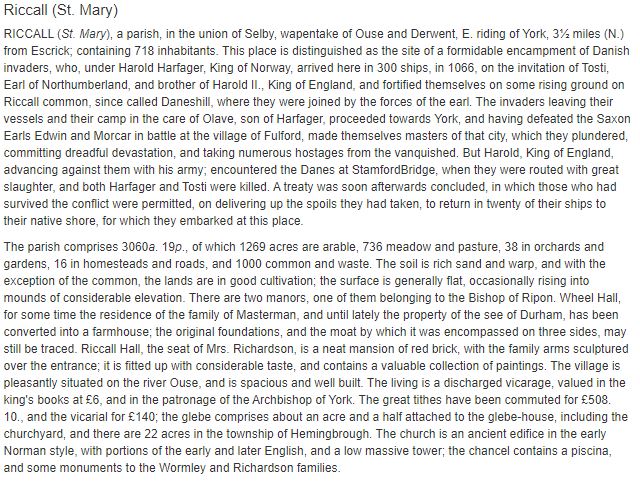
By the 1841 census Guy had become a shoemaker, a trade he continued until the 1861 census, the last he was recorded in. Riccall, in Lewis’s 1848 topographical directory, had a population of 718 as described in the following extract from it:
Guy died on 11 July 1861 and was buried in St Mary’s Churchyard on 14 July 1861.
Guy and Mary’s children – The dandelion chart in the previous section shows their 12 children. Their eldest son Guy became a tailor and moved to Appleton Roebuck, George a labourer was buried in Riccall, Mark became a shoemaker and was buried in Riccall, William is the subject of the next section and their youngest son Robert died in infancy.
Mary, Susannah and Ellen all married farmers. Bessy married a glass bottle packer and Jane a tanner. Ann married a brickyard labourer and moved to nearby Kelfield. Their fifth daughter Isabella (1830-1885), my three times great grandmother, married Thomas Foster (1825-1902), a brick and tile maker, on 4 March 1848. They settled in the nearby village of Kelfield.
Alleged army fraud – William Silversides (1829-1912) is my 1st cousin 4 times removed and the brother of my three times great grandmother Isabella. By the 1851 census William had moved to Ebenezer Place in the parish of York St George where he was living with his sister Jane and her husband Thomas Pickersgill. William’s occupation was butcher. He married his first wife Frances Walker (1814-1874) on 29 August 1853. They lived at no 33 Shambles, York in both the 1861 and 1871 censuses with William’s occupation a butcher.
William’s first wife, Frances, died in 1874 and he married his second wife Emma Jane Smith (1834-1900) two year later. They had one daughter, Ethel Beatrice Silversides (1879-1959), and in 1881 the family were living at The Priory, Grange Crescent, York. This property exists to this day and is now run as a small hotel. William’s occupation was recorded as an army contractor. Grange Crescent is near to the army barracks in the Fulford Road.
At some point William had gone into partnership with his first wife Frances’ brother Ambrose Walker (1821-1896) as farmers of Naburn Lodge Farm, Askham Bryan. Ambrose was also a butcher in the 1861 census but by 1881 he described himself as a forage contractor. The dissolution of William and Ambrose’s partnership for the farm, by mutual consent, was reported in the 23 February 1884 edition of the Yorkshire Gazette. In the same newspaper, notice was also given of the dissolution of a partnership between William, Ambrose and Ambrose’s nephew John Philips Walker (1855-1892) who were acting as army contractors in York. This seems to have taken place in advance of a case brought before York Crown Court in 1885 of alleged army fraud.
The alleged fraud case was reported in the 1 August 1885 edition of the Yorkshire Gazette. The case was before Mr Justice Mathew. William Silversides and Ambrose Walker, army contractors, and Thomas Christopher Lewis, butcher were indicted:
“that they did unlawfully conspire, combine, confederate and agree together, in the years 1883 and 1884, at the township of Gate Fulford, having contracted to supply 3100 tons of forage and straw, and also a certain quantity and quality of meat, did from time to time deliver less weight and inferior quality, and that they by falsely pretending they had delivered the said forage, straw and meat of the quantity and quality contracted for, did receive the contract price for the same, with intent to defraud Her Majesty’s Secretary of State for War; and in pursuance of the said conspiracy did pay certain sums of money to one John Anderson Banks, to bribe and induce him to permit the said breaches of contract to be made, with intent to defraud the said Secretary of State.” (Yorkshire Gazette 1 August 1885, page 1)
All three defendants entered a plea of not guilty and the case took place over three days. It seems that not all the defendants were indicted on every charge. John Anderson Banks mentioned in the charges was the Quartermaster of the 5th Dragoon Guards and was key to the provision of forage to the troops. This particular aspect related to tenders which had been won by William Silversides to provide forage during the period August 1882 to 1884. The prosecution asserted that short measures of oats had been supplied and that, although this had been noticed by the troops, it wasn’t until July 1884 that Troop Serjeant Major Saul found that the oats were short by 44lb that the matter was raised with Lieutenant Gore.
The charges against Ambrose and Thomas Christopher Lewis (who was married to his niece) were regarding the quantity and quality of meat supplied to the troops. It was also alleged that they paid bribes to Banks. Banks had been arrested when the regiment arrived in Manchester but had absconded and not been seen since.
A large number of witnesses for the prosecution appeared at the trial, including five Corporals and John Chipchase who was a journeyman butcher who had worked for Lewis. His view was that the meat supplied was often from diseased animals and “he would not have liked to eat the meat himself”. It seems that he had been let go by Lewis and that when he had previously worked for William Silversides as a butcher, the meat he served hsd been passed was by the health inspectors.
A similarly large number of witnesses appeared for the defendants attesting to their good character; these included a number of officers from the barracks. Both barristers for William and Ambrose closed their remarks to the jury with the assertion that the prosecution had not proved its case. Lewis’ counsel said that the money paid to Banks was the result of “betting transactions”.
There was then some to-ing and fro-ing between the jury foreman, the court and the judge. Eventually the defendants were found not guilty in both cases and were discharged.
After the case William spent some time as a hotel proprietor of the Sea Horse Hotel, Fawcett Street, York where he was recorded as living in 1891. The building is now grade II listed. He also seems to have continued his association with Ambrose as probate was granted to him when Ambrose died in 1896.
By 1901 William was a widower for the second time and living on his own means at The Priory, Fulford Road, York. He had moved to 1 Wilton Terrace, Fulford Road, York by 1911 and was described as a retired farmer and butcher. Probate was granted to his daughter Ethel.
Finally, the brick wall – I would like to know more about all the people mentioned in this blog post, and in particular, if there is any information about the parents of my seven times great grandfather William Silversides. I have found some possible family members who lived in Stillingfleet; however, the parish records are rather damaged making it problematic to determine family relationships. Do contact me if you have any further information which you are willing to share.
Researching my ancestors has become something of a passion for me and I really enjoy writing stories about the people I’ve met in this way. From time to time though, I find things out which result in me having a more sombre view of life in a rural village.
A recent example of this relates to the Richardson family; my great grandmother was a Richardson. I was surprised to see that I hadn’t completed all the birth, marriages and deaths information for part of this family who lived in Yorkshire in the late 19th century. As I progressed with the task I came across Mary Ann Richardson, my first cousin three times removed, who as a young child was injured in a fire and subsequently died. The accident happened when both her parents were at work and her two brothers were playing outside in the yard. It looks like she got too close to the stove and her clothes caught on fire. The inquest record explains that one of their neighbours saw her “with her clothes blazing all around”; and that Leonard Smales, a farm labourer, “seized her and rolled her on the floor” to put out the flames. Mary had burns to her legs, body, chest, chin and ears and although her wounds were attended to, she died. Rather poignantly the 1875 burial record for Mary records that she died aged four and three quarter years.
Life in rural Yorkshire wasn’t easy; both of Mary’s parents were working as labourers, Joseph on the railway and her mother Elizabeth on the land. They were at work the day the accident happened, a Saturday. By 1881 they had moved to a nearby village and Joseph was described as a railway platelayer for the North Eastern railway who perhaps had moved with his job?
Sometimes even brief records can pack an unexpected punch. On a recent visit to the East Yorkshire archives in Beverley I handled a small document which recorded the indictment and sentence of my five times great grandfather. Elias was given 7 years transportation for stealing a variety of grains; perhaps either to sell and/or feed his family. He never made it to one of Britain’s colonies though. Elias died in 1812 in a prison hulk ship moored off Portsmouth, probably of hulk fever. I tried to find out more information about his burial but it looks like prisoners were just put in unmarked graves or worse.
Seeing both these records gave me an almost visceral connection to the past, something which I was really surprised about. Sad those these stories are, it won’t stop me doing my research; and their stories deserve to be told, it has also made me more aware of the conditions my ancestors endured in a part of rural Yorkshire which I experienced very differently as a child. To me it meant freedom, fresh air and the chance to read and learn. For them it was more about the daily grind and being able to feed their families. Despite the current climate, in comparison to their lives, I feel very lucky to live in the present time.
 Joan Reid Genealogy