Category Archives: Ellis

Joseph Henry Burt 1828-1913

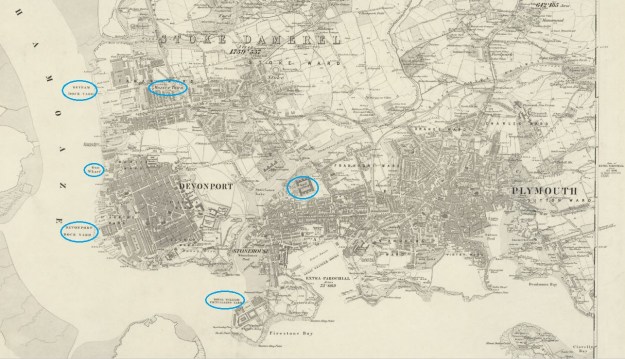
Joseph is linked to my Ellis ancestors through his sister Elizabeth Small Burt (1812-1894) and her husband George Brown (1811-1897), who are my three times great grandparents. Their daughter Elizabeth Small Brown (1844-1916) married my two times great grandfather Francis Ellis (1839-1925) in Portsea, Hampshire, where he was serving in the Coastguard service. The following OS map has been annotated with a number of locations where George and Elizabeth lived with their family in the 19th century.
Joseph, according to his naval record, was born on 14 January 1828 in Torpoint, Cornwall to parents Jacob Burt (1781-1873) and Elizabeth Small (1782-1845). In the 1841 census the family are living in Antony in Cornwall and Jacob is a ropemaker. At the age of 22 Joseph joined the navy on 23 October 1849 and was described as a cooper. This was just over a year after he had married his wife Emma Betty in Q2 1848 in East Stonehouse, Devon. Their daughter Emma Jane Burt (1848-1925) was born not long after in Devonport.

Joseph’s naval service record paints a picture of his physical features. He was 5ft 5in tall with light brown hair, a fair complexion and light hazel eyes with no distinguishing marks. It also gives an interesting insight into his career in the Royal Navy. From 23 October 1849 until 4 June 1852, Joseph served on HMS Conflict, a wooden sloop, based in south east America until it returned to Portsmouth. He then served on HMS Hogue, an unarmoured wooden screw vessel, from 1 September 1852 until 23 May 1856. Initially it was a guard ship in Devonport, before it went to the Baltic in 1854 during the Russian war. It was reported in the Times of 6 March 1854 that it was one of several ships which had been victualled at Spithead (near Portsmouth) for six months foreign service.

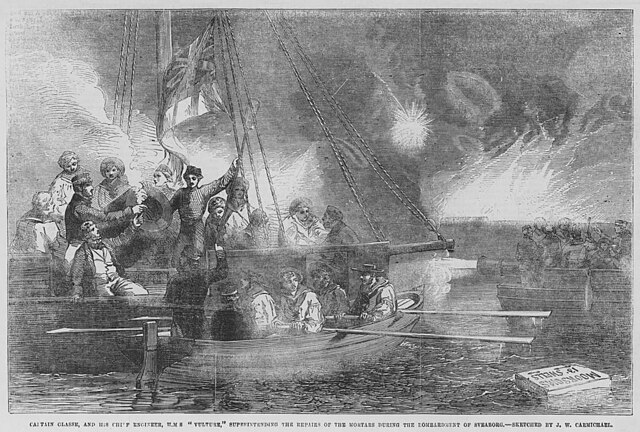
On 24 May 1856 Joseph joined HMS Vulture. It was damaged at the Bombardment of Sveaborg and the illustration is a sketch by James Wilson Carmichael of Captain Glasse and his Chief Engineer supervising its repairs. While Joseph served on HMS Vulture it saw service in the Mediterranean and frequently spent time in Malta and Gibraltar, as well as places like Serpents’ Island in the Black Sea, Sevastopol and then the Bosphorus. The last three places were reported by an officer on HMS Vulture in a letter reproduced in the Glasgow Courier, 27 November 1856, p4.

When HMS Vulture returned to Spithead in 1860 it was inspected and then steamed into Portsmouth. Joseph would have been one of the crew who subsequently boarded the Pigmy steamer bound for Devonport and the chance to be reunited with his family (report in the Naval and Military Gazette and Weekly Chronicle of the Service, 7 April 1860, p3.)
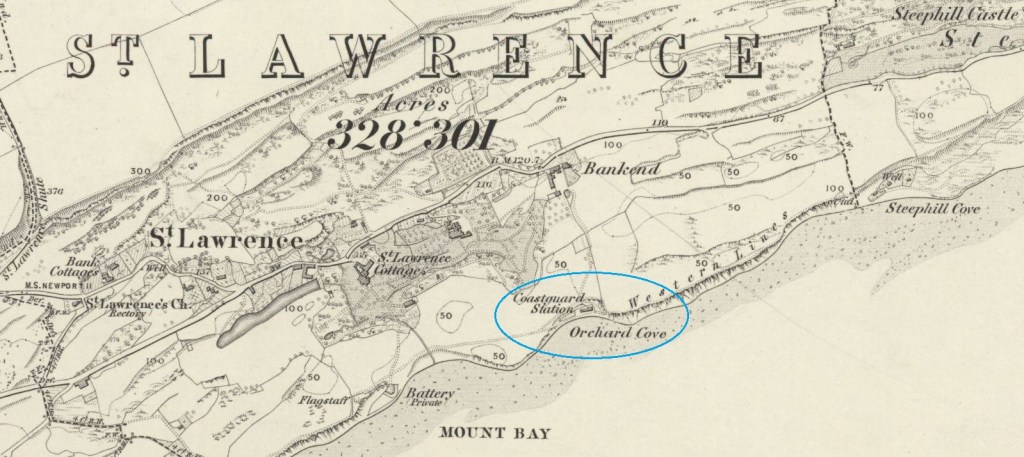
Joseph’s last ship, before he joined the coastguard service, was HMS Impregnable, from 6 April 1860 to 22 May 1860. His first posting as a coastguard was as a boatman and in 1861, he is living with his wife and daughter in Victoria Terrace, Ventnor and described as a coastguard and retired cooper. The coastguard station was to the west of Ventnor as shown on the following OS map (Hampshire and Isle of Wight Sheet C, published 1866). It no longer exists.
Joseph’s record of his coastguard service updates his physical appearance. He is still 5ft 5in tall and with a fair complexion. However, his hair is now described as brown and his eyes grey and he has scars on his right knee and right elbow. On 27 April 1868, while still at Ventnor coastguard station, Joseph was promoted to commissioned boatman; a position he held until 30 April 1873. He was appointed chief boatman on 1 May 1873 and on 6 May 1873 he moved to the coastguard station at Ryde.

Joseph moved back to Ventnor coastguard station on 16 June 1874 was promoted to chief boatman in charge on 7 June 1877. His next move, as chief boatman in charge, was to Crowlink, Sussex on 20 June 1877. He stayed there a couple of years before moving to Cuckmere Haven, Sussex on 5 October 1879.

Joseph was granted a pension on 19 December 1882 and by the 1891 census had returned to the Isle of Wight, where he lived at Bettesworth Rd, Ryde until he died on 5 July 1913. He left effects to the value of £359 1s 7d to his widow Emma. Emma (1826-1915) died at the age of 88 on 15 December 1915. She left effects to the value of £192 15s 6d to her daughter Emma Jane.

Do let me know if you have any stories about them which you are willing to share with me.

Note: the maps used in this blog has been reproduced with the permission of the National Library of Scotland under the following creative commons licence https://creativecommons.org/licenses/by-nc-sa/4.0/ and sourced from the NLS maps site https://maps.nls.uk/.

Bibliography:

Births, marriages and deaths. https://www.ancestry.co.uk/ : accessed February 2025.

Bombardment of Sveaborg. https://www.rmg.co.uk/collections/objects/rmgc-object-12128 : accessed February 2025.

Carmichael, James Wilson. Captain Glasse, and his Chief Engineer, H.M.S. “Vulture,” superintending the Repairs of the Mortars during the Bombardment of Sveaborg. Illustration for The Illustrated London News, 5 April 1856. James Wilson Carmichael, Public domain, via Wikimedia Commons.

Census records. https://www.ancestry.co.uk/ : accessed February 2025.

England and Wales, Non-Conformist and Non-Parochial Registers. https://www.ancestry.co.uk/ : accessed February 2025.

Glasgow Courier. https://www.findmypast.co.uk/home : accessed February 2025.

Naval and Military Gazette and Weekly Chronicle of the Service. https://www.findmypast.co.uk/home : accessed February 2025.

OS Maps. https://maps.nls.uk/ : accessed February 2025.

Probate records. https://www.ancestry.co.uk/ : accessed February 2025.

Victorian Royal Navy. https://www.pdavis.nl/index.htm : accessed February 2025.

UK, Royal Naval Seamen Index, 1853 -1872. https://www.ancestry.co.uk/ : accessed February 2025.

UK, Royal Navy Registers of Seamen’s Services, 1848-1939. https://www.ancestry.co.uk/ : accessed February 2025.
George Brown (1811-1879) – 3rd great grandfather

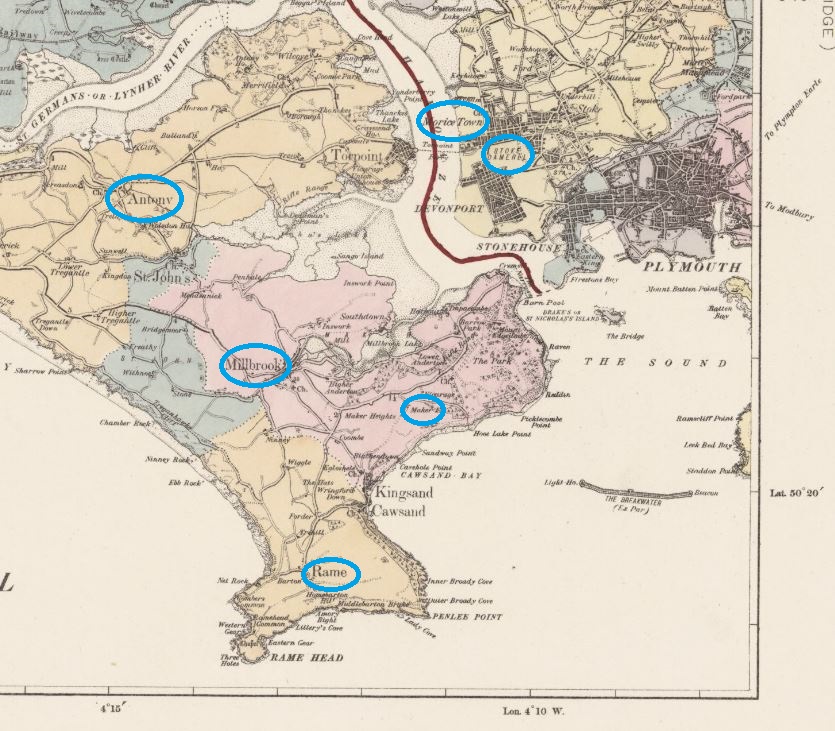
I have recently become interested in my Cornish/Devon ancestors; a group I’d largely neglected as they have the surname Brown. There is now a page for them on my website and over time I intend to write blog posts about various members of the family. This post is about George, my 3rd great grandfather, who was born in Cornwall to parents Ambrose Brown (1787-1862) and Thomasin Friendship. He was baptised on 24 February 1811 in Maker, Cornwall. The following OS map (OS sheet 348 Plymouth d ca. 1892) has been annotated with a number of locations where he lived with his family in the 19th century.

George married Elizabeth Small Burt (1812-1894) on 21 March 1832 in Stoke Damerel, Devon. George and Elizabeth had at least six children although not all of them reached their teens. A combination of baptism, birth, census and death records revealed a number of locations where the family lived, as well as George’s occupation:

  • 25 July 1833 – daughter Thomasin Elizabeth Brown baptised in the Wesleyan chapel, Morice St, Devonport. George and Elizabeth were both named on the record; George was a ropemaker from Millbrook, Cornwall.
  • 5 April 1835 – daughter Eliza Jane Brown baptised in Millbrook, Cornwall. George and Elizabeth were from Maker, Cornwall.
  • 2 April 1838 – son George William Burt Brown born at 12 Portland Place in the parish of Stoke Damerel; father George a ropemaker. Son George died on 6 June 1839 of disease of the brain. The family were living at 26 Garden St in the parish of Stoke Damerel. Father George was described as a ropemaker in Her Majesty’s dockyard.
  • October 1840 – son George William Brown born at 26 Garden St in the parish of Stoke Damerel. Father George a ropemaker.
  • 6 June 1841 census – George, a ropemaker, Elizabeth and three children living in Garden St, Devonport.
  • 6 March 1842 marks the death of son George William Brown of inflammation. The family were living at 32 Navy Row, Morice Town and father George was described as a ropemaker.
  • 30 October 1842 – son John Edwin Small Brown born at 32 Navy Row, Morice Town. Father George a ropemaker.
  • 30 December 1844 – daughter Elizabeth Small Brown born at 7 York Place, Stoke Damerel. Father George a ropemaker in the Devonport dockyard.
  • 30 March 1851 census – George, Elizabeth and four children living in Harvey St, Antony, Cornwall with George described as a ropemaker.

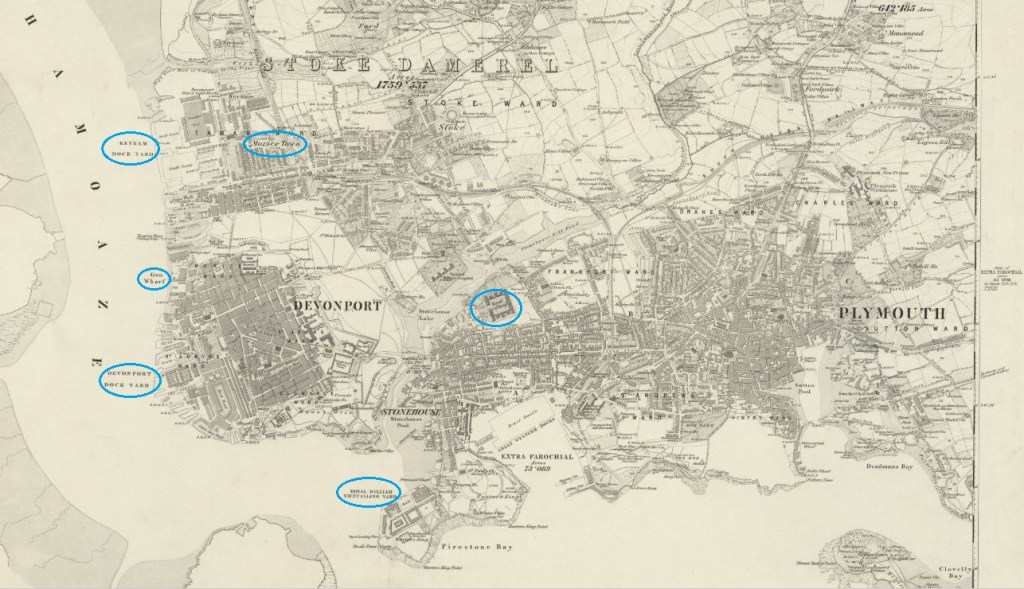
Until at least 1851 George worked in the Devonport dockyard, probably in the East Rope house. It was completely open plan and comprised 57 bays with cellars and three stories. Ropemaking involved taking hemp fibres and twisting them into strands and then twisting the strands into ropes. This was achieved by using a machine to rotate the hemp fibres as the men walked backwards along a ropewalk while releasing their supply of hemp. (The following OS map Devonshire sheet CXXXIII date 1867 shows the location of the dockyard as well as other places linked to the Brown family).

By the 1861 census George, Elizabeth, daughter Elizabeth and grandson William Turner (1854-1922) were living at 39 Princes St, Portsea, Hampshire, where George was described as a sawyer. This is no doubt where Elizabeth met and married my 2nd great grandfather Francis Ellis (1839-1925).

In the 1871 census George and Elizabeth had moved back to Cornwall. They were living in St Andrew St or Back St in Maker and George was a ropemaker pensioner. George died on 14 August 1879 at St Andrews St, Millbrook Maker. He had been suffering from Phthisis Pulmonalis (tuberculosis) for four years and exhaustion for six months. It is possible that the 1861 census record of George’s occupation is incorrect as, when his death was registered by his daughter Elizabeth, he was described as formerly a ropemaker at HM Dockyard Portsmouth.

Do let me know if you have any stories about them which you are willing to share with me.

Note: the maps used in this blog has been reproduced with the permission of the National Library of Scotland under the following creative commons licence https://creativecommons.org/licenses/by-nc-sa/4.0/ and sourced from the NLS maps site https://maps.nls.uk/.

Bibliography:

Bennett, George. (2017) Dockyard, Naval Base and Town: The Social and Political Dynamics of Plymouth 1800-1950. http://hdl.handle.net/10026.1/10135 : accessed June 2023.

Births, marriages and deaths. https://www.ancestry.co.uk/ : accessed June 2023.

Census records. https://www.ancestry.co.uk/ : accessed June 2023.

Cornwall On-line Parish Clerks. https://www.opc-cornwall.org/ : accessed June 2023.

Devonport naval dockyard. https://navaldockyards.org/devonport-dockyard/ : accessed June 2023.

East Rope House, Devonport. http://www.olddevonport.uk/Royal%20Dockyard-South%20Yard-East%20Rope%20House%20S%20132.htm : accessed June 2023.

England and Wales, Non-Conformist and Non-Parochial Registers. https://www.ancestry.co.uk/ : accessed June 2023.

Lewis, Samuel ed. (1848) A Topological Directory of England. London: Lewis. https://www.british-history.ac.uk/topographical-dict/england : accessed June 2023.

Maker. https://www.genuki.org.uk/big/eng/CON/Maker : accessed June 2023.

OS Maps. https://maps.nls.uk/ : accessed June 2023.

Probate records. https://www.ancestry.co.uk/ : accessed June 2023.

Rame. https://www.genuki.org.uk/big/eng/CON/Rame : accessed June 2023.

Stoke Damerel. https://www.genuki.org.uk/big/eng/DEV/StokeDamerel : accessed June 2023.

James Harvey Bean MD (1858-1910)

James is my second cousin four time removed on the Ellis side of my family. He was born on 10 February 1858 in Roxbury, Suffolk, Massachusetts, USA. James’ parents were James Bean (1822-1899) and Harriet Harvey (1821-1876). James and Harriet had nine children, five of whom were born in Yorkshire, England and the remaining four in USA.

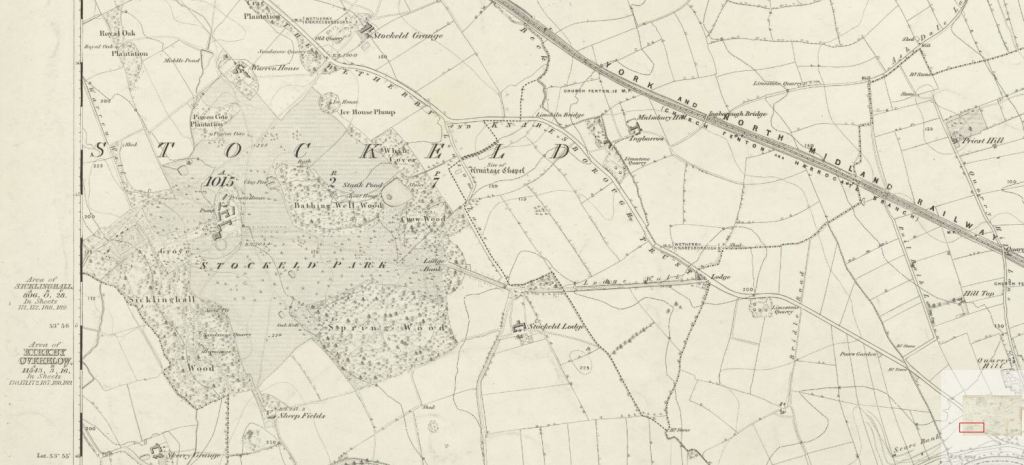
Prior to their emigration to the USA, James was a gardener living at the Garden House, Spofforth, Yorkshire and working on the Stockeld Park Estate. The following map (OS Yorkshire sheet 172 date 1850) shows the extent of Stockeld and its location near the York and North Midland railway line.

James, Harriet and their children Mary, Elizabeth, William and Charlotte left Liverpool on the ship Mariner, and arrived in the port of Boston on 12 May 1854.  The family settled in Roxbury where James continued to work as a gardener and I have previously written about his life in USA .

James Harvey Bean was the first of James and Harriet’s children to be born in USA. He trained as a physician at the Jefferson Medical College at the Thomas Jefferson University in Philadelphia. James married Nellie Priestley (1863-1953) on 15 January 1883 and by 1900 they were living in Bannock, Pocatello, Idaho.

James and Nellie didn’t have children and James died on 8 June 1910 in Los Angeles, California, apparently of uremia, caused by irreversible damage to the kidneys. He was buried in Mountain View Cemetery, Pocatello, Bannock County, Idaho.

After his death Nellie applied to the Idaho court for probate as the sole beneficiary and executor under his will which he had signed on 13 February 1895.  It seems that during his lifetime James had acquired a number of lots of land in Pocatello and created the South East Securities Corporation which Nellie took over after his death. Issues relating to the ownership of property in Weber County and Salt Lake, Utah were resolved by the Utah court in 1911, and the court decreed that this property also become the property of Nellie.

Nellie did not remarry and was considered a pioneer in Pocatello. On 16 June 1938 she was deemed in contempt of court for failing to sign over bonds to pay a labour debt and was jailed. She remained in jail even though friends had agreed to pay the debt (The Post Register 4 August 1938).  Nellie died aged 90, on 2 January 1953, at her home 208 West Clark, Pocatello. She was buried in the family plot in Mountain View cemetery and left an estate worth $6853.

Note: the map used in this blog has been reproduced with the permission of the National Library of Scotland under the following creative commons licence https://creativecommons.org/licenses/by-nc-sa/4.0/ and sourced from the NLS maps site https://maps.nls.uk/.

Bibliography:

Births, marriages and deaths. https://www.ancestry.co.uk/ : accessed December 2022.

California Death Index, 1905-1939.  https://www.ancestry.co.uk/ : accessed December 2022.

Directory of Deceased American Physicians, 1804-1929. https://www.ancestry.co.uk/ : accessed December 2022.

English Census Records. https://www.ancestry.co.uk/ : accessed December 2022.

Idaho, US Death Records, 1890-1969. https://www.ancestry.co.uk/ : accessed December 2022.

Idaho, US Wills and Probate Records, 1857-1989. https://www.ancestry.co.uk/ : accessed December 2022.

Massachusetts Town and Vital Records, 1620-1988. https://www.ancestry.co.uk/ : accessed December 2022.

Massachusetts US State Census. https://www.ancestry.co.uk/ : accessed December 2022.

OS Maps. https://maps.nls.uk/ : accessed December 2022.

Passenger Records. https://www.ancestry.co.uk/ : accessed December 2022.

Stockeld Park. https://stockeldpark.co.uk/blog/the-stockeld-story-history-of-stockeld-park/ : accessed December 2022.

United States Federal Census. https://www.ancestry.co.uk/ : accessed December 2022.

US, City Directories, 1822-1995. https://www.ancestry.co.uk/ : accessed December 2022.

US Find a Grave Index, 1600s to Current. https://www.ancestry.co.uk/ : accessed December 2022.

US Newspapers.com Obituary Index, 1800s to Current. https://www.ancestry.co.uk/ : accessed December 2022.

Utah, US Wills and Probate Records, 1800-1985. https://www.ancestry.co.uk/ : accessed December 2022.

James Bean 1822-1899

James is my first cousin five times removed and I decided to write about him because his father was a nurseryman/ market gardener like mine. James and his family also emigrated to the USA in the mid-19th century.

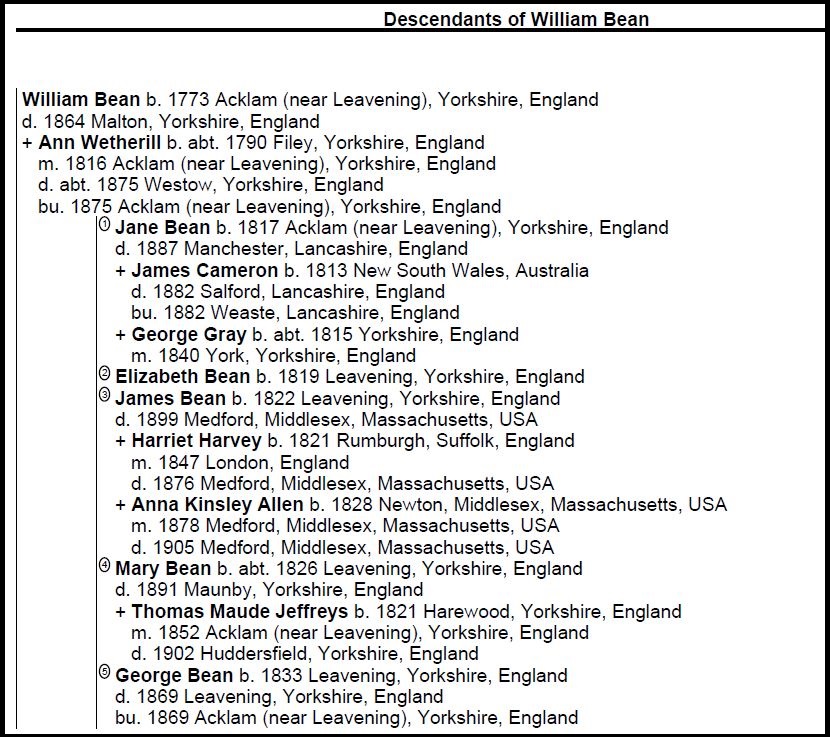
James was the eldest son of William Bean (1773-1864) and Ann Wetherill’s (1790-1875) five children. They had married on 31 October 1816 in Acklam parish church and settled in nearby Leavening; both places are in what was the North Riding of Yorkshire. The following outline descendant chart shows their immediate family:

Outline descendant chart for William Bean and Ann Wetherill

William and Ann continued to live in Leavening; in the 1841 census William was recorded as a nurseryman. Lewis’ topographical directory of 1848 described Leavening as follows:

Leavening from Lewis’ 1848 topographical directory of England

Two of William and Ann’s children moved away from Yorkshire. Their eldest daughter Jane (1817-1887) had moved to York by 1840, when she married her first husband George Gray (born 1815). By 1871 she was living in Chorlton cum Hardy, Lancashire with her second husband, James Cameron (1813-1882), who was described as a “survivor of the Charge of the Light Brigade”, and a private in the 13th Light Dragoons, on his Find A Grave record.

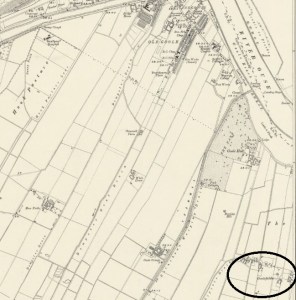
James was their second child to leave Leavening. He married Harriet Harvey (1821-1876) in St Botolph’s Church, Bishopgate, London on 11 April 1847, when James was described as being from Featherstone in Yorkshire. Their first child Mary was born in Featherstone in 1848. By 1851 James was a gardener at Stockeld Hall, near Spofforth, in the West Riding of Yorkshire.

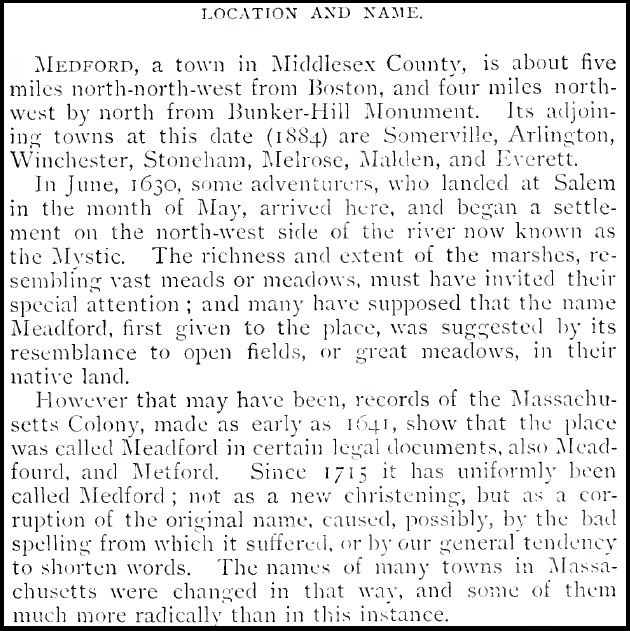
James, Harriet and children Mary, Elizabeth, William and Charlotte, left Liverpool on the ship Mariner and arrived in Boston on 12 May 1854. James’ naturalization certificate recorded his arrival date as 13 May 1854; perhaps the date they actually left the ship. On the passenger list James described himself as a gardener. Initially the family were found in the 1855 Massachusetts State Census in Roxbury, near Boston, where James was a gardener. The family had moved to Medford, Massachusetts by 1859. Medford was described in a local history as follows:

Usher, page 13

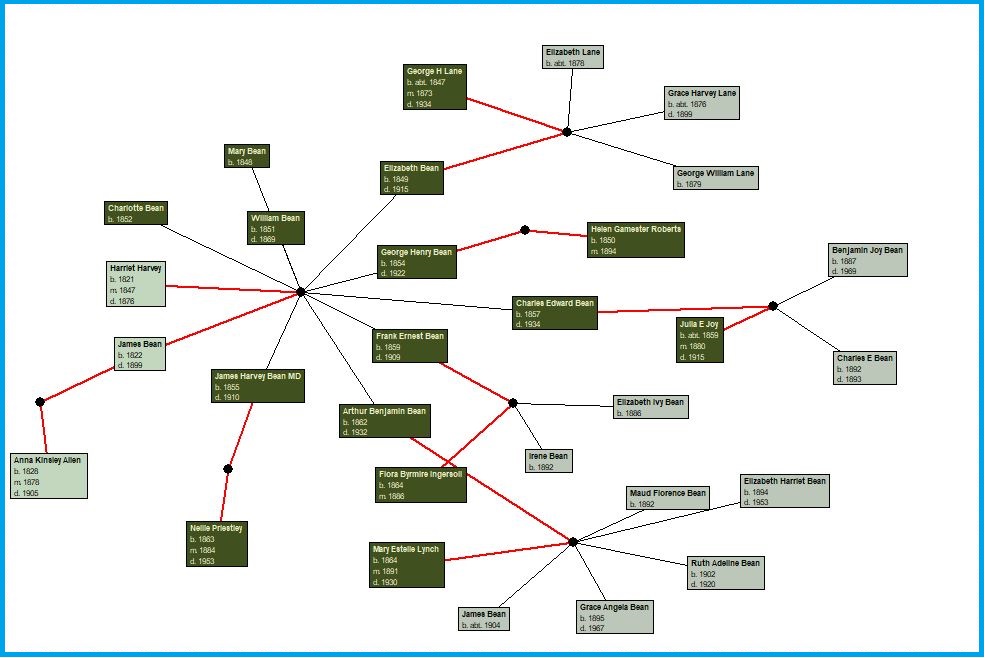
James and Harriet had nine children before she died on 29 March 1876. The following chart shows their family, as well as James’ second wife Anna Kinsley Allan (1828-1905), who he married on 20 November 1878.

Dandelion chart for James Bean

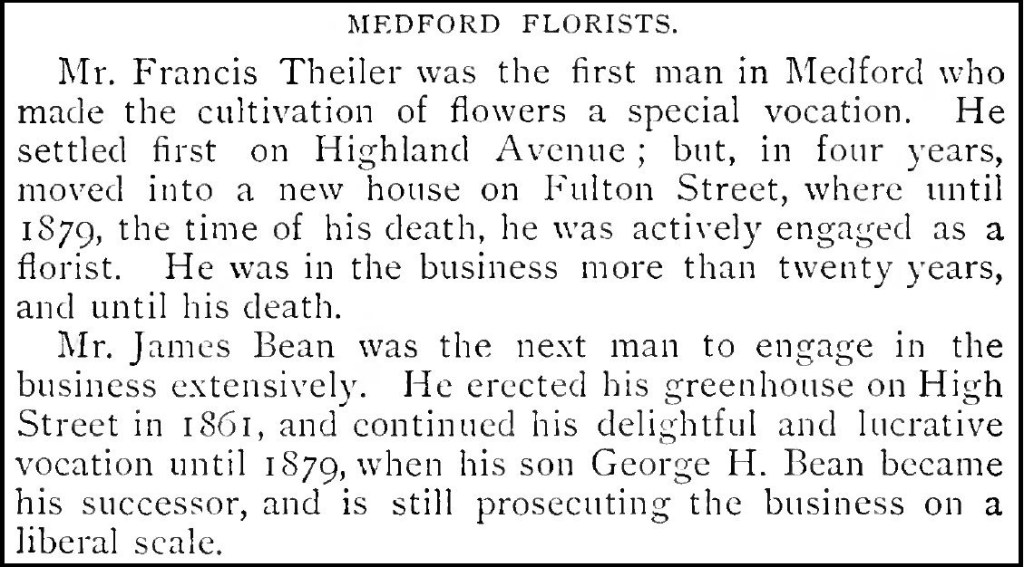
The book of the history of Medford also provided information on what James did when he settled there. The following extract describes how he set up in business as a florist which, he then passed onto his second son, George Henry Bean (1854-1922):

Usher, page 437

After he passed the business onto his son George, James became a coal dealer. It was recorded as his occupation on his death record, when he died on 19 June 1899. It seems that his daughter Charlotte (born 1852) continued in the business for some time after his death.

I am interested in knowing more about James and his descendants. Do contact me if you have any further information which you are willing to share with me.

Bibliography

Acklam and Leavening. https://www.genuki.org.uk/big/eng/YKS/ERY/Acklam : accessed February 2022.

Births, baptisms, marriages, deaths and burials. https://www.ancestry.co.uk/ https://findmypast.co.uk : accessed February 2022.

Lewis, Samuel ed. (1848) A Topological Directory of England. London: Lewis. https://www.british-history.ac.uk/topographical-dict/england : accessed February 2022.

Massachusetts, U S, Arriving Passenger and Crew Lists Records, 1820-1963. https://www.ancestry.co.uk/ : accessed February 2022.

Massachusetts, U S, State and Federal Naturalization Records, 1798-1950. https://www.ancestry.co.uk/ : accessed February 2022.

Massachusetts, U S, State Census Records, 1855. https://www.ancestry.co.uk/ : accessed February 2022.

Massachusetts, U S, Town and Vital Records, 1620-1988. https://www.ancestry.co.uk/ : accessed February 2022.

Spofforth. https://www.genuki.org.uk/big/eng/YKS/WRY/Spofforth : accessed February 2022.

UK and Ireland, Find A Grave Index, 1300s to Current. https://www.ancestry.co.uk/ : accessed February 2022.

US State Federal Census Records. https://www.ancestry.co.uk/ : accessed February 2022.

Usher, James. (1886) History of the Town of Medford, Middlesex County, Massachusetts. Boston: Rand, Avery and Co. https://archive.org/ : accessed February 2022.

Annie Morley (born 1871) – was she the actress Madge Morley?

I’ve previously written about Annie, my 2nd cousin three times removed, in two posts on my blog: two actors and an accidental drowning and George Curryer’s will. George married Annie on 10 June 1890 in Folkestone, Kent. He gave his occupation as an actor and his condition on their marriage certificate was recorded as a widower; however, Annie was George’s second wife.

After their marriage, George and Annie, and their two-month-old daughter Madge (1891-1940), were next found in the 1891 census living in Scarborough with Annie’s mother Maria and her second husband James Davison (b. 1852). George’s occupation was recorded as an actor. Maria and George went on to have a son Henry (1893-1920). However, after 1891, George and Annie, do not appear together in any further census records. The admission records of Acomb National School do though provide some further clues as to their whereabouts:

 Madge Morley CurryerHenry Edwards Curryer
Date admitted to Acomb school26/04/189719/03/1900
Birth date27/01/189111/09/93
ParentGeorge 4 Whitehall Cottages, AcombAnnie 4 Whitehall Cottages, Acomb
Previous schoolAll Saints, ScarboroughPrivate school
Date left10/01/190512/04/1900
Date admitted 07/01/1901
Date left 22/02/1901
Date admitted 27/08/1901
Date left 04/10/1901

It seems that by April 1897 George, Annie and their two children were at least using 4 Whitehall Cottages, Acomb as their address for the purpose of Madge’s and then Henry’s education. However, when Henry entered the school in March 1900, his parent was recorded as his mother Annie. An entry in the “Professional Cards” section of The Stage (7 March 1895) also provided useful information:

“MR. GEORGE EDWARDS, Lead or Character. MADGE MORLEY, Juvenile Lead, Light Comedy. Liberty. 48, Tenison-st., Lambeth, S.E.”

It looks like George’s stage name was George Edwards and Annie’s was Madge Morley. However, they had probably gone their separate ways by 8 July 1897 when Annie’s Professional Card in The Stage read as follows:

“MISS MADGE MORLEY, Disengaged Autumn. Comedy or Drama. “The pathos instilled into the part of Marie, a blind girl, by Madge Morley makes her at once a favourite and enlists the sympathy of the audience.” Northern Guardian, June 22nd 1897. Address, 4 Whitehall Cottages, Acomb, York.”

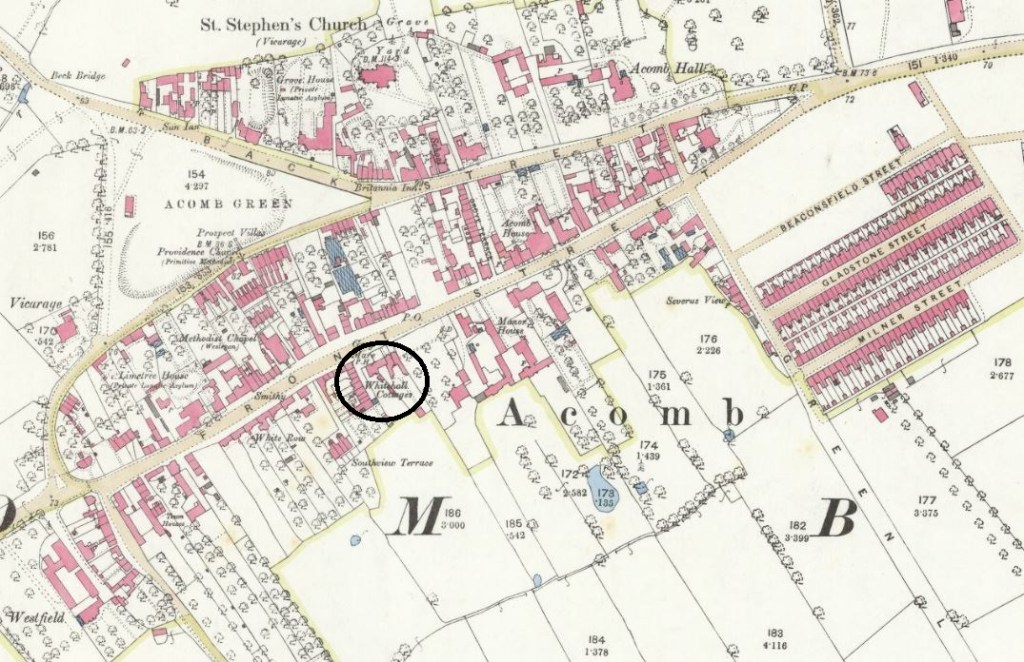
Returning to their son Henry’s education records, he finally left Acomb School at the age of eight on 4 October 1901. In the 1901 census Henry was with his father George, living with George’s brother William, at 62 Vicarage Rd, Tottenham. Annie (as Madge Morley) was at 1 Tidy St, Brighton, where she was described as a married actress. Their daughter Madge was at 4 Whitehall Cottages, Acomb with Frederic and Sarah Brown and described as their niece. She was their great niece, as Annie’s mother was Maria, Sarah’s sister. The following map shows the location of the cottages in Acomb.

OS Yorkshire CLXXIV.9 date 1892

By 1911 George had moved to 142 Gladstone Buildings, Willow St, Finsbury where he subsequently died on 17 December 1925. His son Henry joined the Royal Marines on 13 May 1911 and daughter Madge was working as a governess in a children’s home in Walthamstow, Essex in the 1911 census. Annie was recorded as “Madge Morley”, born 1876 in Aldershot, single, an actress, and visitor at Flat 3, 112A Brixton Hill, London in 1911. The head of the household was John Sanders.

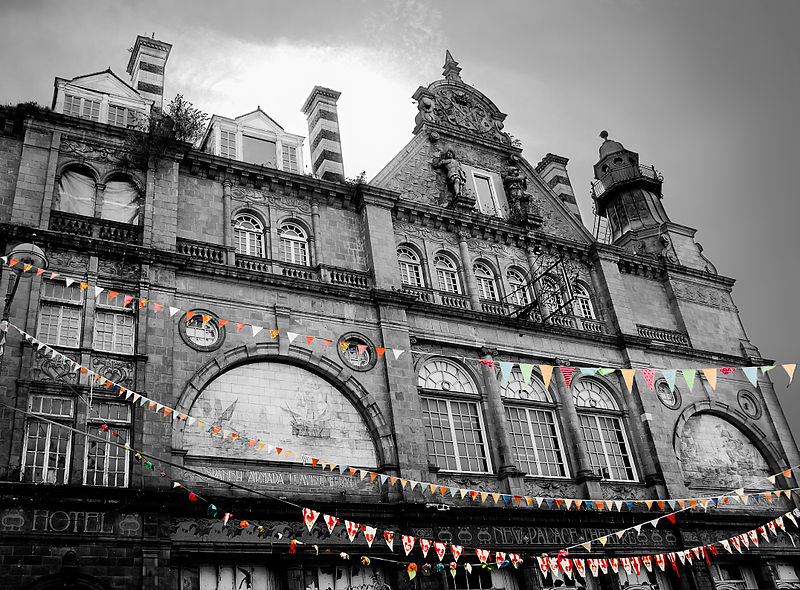
Annie continued to live in London when she wasn’t touring in music halls and theatres. She appeared at the York Empire in May 1912 (Musical Hall and Theatre Review, 2 May 1912), a venue specialising in variety performances. The Western Evening Herald of 10 June 1918 contained an advert for “Miss Madge Morley and company – a farcical absurdity entitled AFTER THE RACES” at the Palace Plymouth, now a disused theatre.

Former Palace Theatre, Union St, Plymouth by miagarrett – unchanged

In the 1920 London Electoral Registers Annie’s address was 128 Brixton Hill. This was the address recorded for her, as her son Henry’s next of kin, when he died by accidental drowning on 9 March 1920 in South Africa. A further search of The Stage for later entries for Annie, with the stage name Madge Morley, found an entry in the death’s column of the 12 September 1929 issue:

“John Sanders – died 28 August 1929, age 48, after a short illness. Deeply mourned by his wife, Madge Morley.”

Another look at Annie’s 1920 Electoral Register entry showed that John Sanders was also living at 128 Brixton Hill. In addition, there were further entries in The Stage (for example, 27 January 1921 and 20 October 1921) posted by Madge Morley seeking work. In all cases her address was 128 Brixton Hill. Eventually I found a marriage between Annie Curryer and John Sanders on 24 December 1925. She had waited just a week after George’s death before marrying John. The couple were married by license in the Lambeth Registry Office. John was a bachelor and commercial traveller (textiles) living at 128 Brixton Hill. Annie was described as a widow with no rank or profession and her address was 12 Fairmount Rd, Brixton Hill.

After her second husband John’s death on 28 August 1929, Annie continued to advertise for work in The Stage Professional Cards column. Her entry on 24 April 1930 suggested that she was disengaged and seeking special parts, with her address given as 128 Brixton Hill. By this time, she would have been about 60 and was possibly coming to the end of her career on the stage. So far, I’ve been unable to find out what happened to Annie after her second husband died. Do contact me if you have any further information which you are willing to share with me.

Note: the map used in this blog has been reproduced with the permission of the National Library of Scotland under the following creative commons licence https://creativecommons.org/licenses/by-nc-sa/4.0/ and sourced from the NLS maps site https://maps.nls.uk/.

Bibliography

Births, baptisms, marriages, deaths and burials. https://www.ancestry.co.uk/  and https://findmypast.co.uk : accessed January 2022.

Census Records. https://www.ancestry.co.uk/  : accessed January 2022.

Darby, Neil. (2017) Life on the Victorian Stage: Theatrical Gossip. Barnsley: Pen and Sword.

London, England, Electoral Registers, 1832-1965. https://www.ancestry.co.uk/  : accessed January 2022.

Miagarrett. (2014) Former Palace Theatre, Union St, Plymouth. CC BY-SA 3.0 (https://creativecommons.org/licenses/by-sa/3.0/deed.en). https://commons.wikimedia.org/  : accessed January 2022.

Music Hall and Theatre Review. https://www.findmypast.co.uk/ : accessed January 2022.

National School Admission Registers & Log Books, 1870-1914. https://www.findmypast.co.uk/ : accessed January 2022.

OS Maps. https://maps.nls.uk/ : February 2021.

The Stage. https://www.findmypast.co.uk/ : accessed January 2022.

UK, British Army and Navy Birth, Marriage and Death Records, 1730-1960. https://www.ancestry.co.uk/ : accessed January 2022.

Western Evening Herald. https://www.findmypast.co.uk/ : accessed January 2022.

George Hamnette Bean (1864-1958)

I came across George while researching my Bean ancestors. In a family who often worked on the land or as domestic servants he stood out as someone with a different occupation. The 1891 census records him as a musician and I also found a record for him which described him as a bandsman on a ship. But before we get to that I would like to explain his relationship to me; George is my first cousin three times removed.

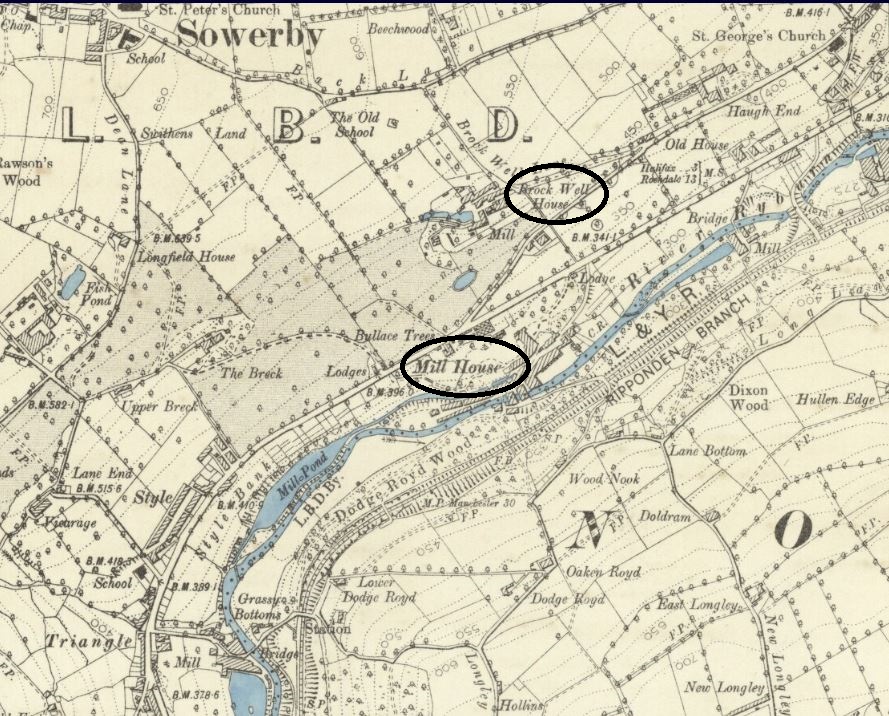
George was the third son of William Bean (b 1837) and Mary Askew (b 1832) and was baptised in the Chapel in Sowerby, Yorkshire on 10th July 1864. His father’s occupation was given as butler and their residence as Lower Brockwell. In the 1861 census George’s parents were both living in Sowerby but in different houses. William was a domestic servant in Mill House which was headed by William Henry Rawson, Deputy Lieutenant, Magistrate and woollen merchant. William’s wife Mary was living at nearby Stansfield Lodge with their first son Frederick Joshua Bean (1859-1869). In 1871 the family were at Brockwell house where William was the butler to the Rawson family (see annotated map). He was still a butler in 1881; George was then aged 15 and a wool teaser.

OSSowerby1894annotated

1894 OS Map showing Sowerby, Brock Well House and Mill House

George enlisted in 21st Hussars as a private in 1882, served in Dublin, Ireland and arrived in Colchester, Essex on 15 July 1887. He married his wife Harriet Ann Wroe (1864-1942) on 19 September 1887 in Colchester. George went with his regiment to India and his military records show that he arrived there on 21 December 1887. Within a year he was in hospital in Bangalore. George served in the East Indies for just over two years and was back home by 19 December 1889. His military record shows that he had completed seven years’ service, and that in 1889 he was transferred to the Army Reserve and discharged in 1894. Unfortunately, the record does not confirm his occupation at the end of his military service, just that he had been a wool teaser when he enlisted. It’s George’s WWI enlistment record for the 2nd East Lancashire Brigade in 1915 which gave his occupation as a musician. It does seem possible that George became a musician during his military service with the 21st Hussars.

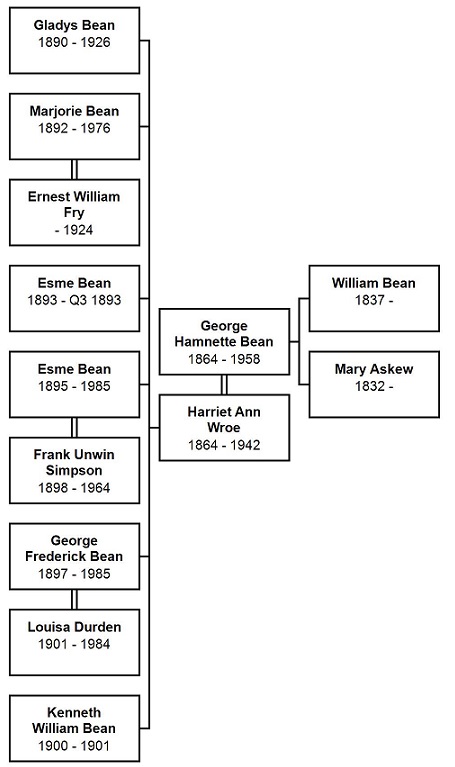
George and Harriet’s first two daughter, Gladys (1890-1926) and Marjorie (1892-1976), were born in Sowerby. By the 1891 census the family were living in Redcar, North Yorkshire when George was described as a musician and their address was No. 2 Beach Cottage. Between 1891 and 1901 George and Harriet had four more children, Esme (1893-1893) born in Yorkshire, and then Esme (1895-1986), George Frederick (1897-1985) and Kenneth William (1900-1901) born in Lancashire. In 1901 the family were living at 6 Molyneux Street, Levenshulme, South Manchester, Lancashire. George’s occupation was recorded as “musician orchestral”.  A record for George in the 1911 census wasn’t found, but one for his wife Harriet was. She was living with four of their children at 26 Clare Road, Levenshulme. Harriet was described as an elementary school head teacher. It is possible that George was working away from home at the time of the 1911 census.

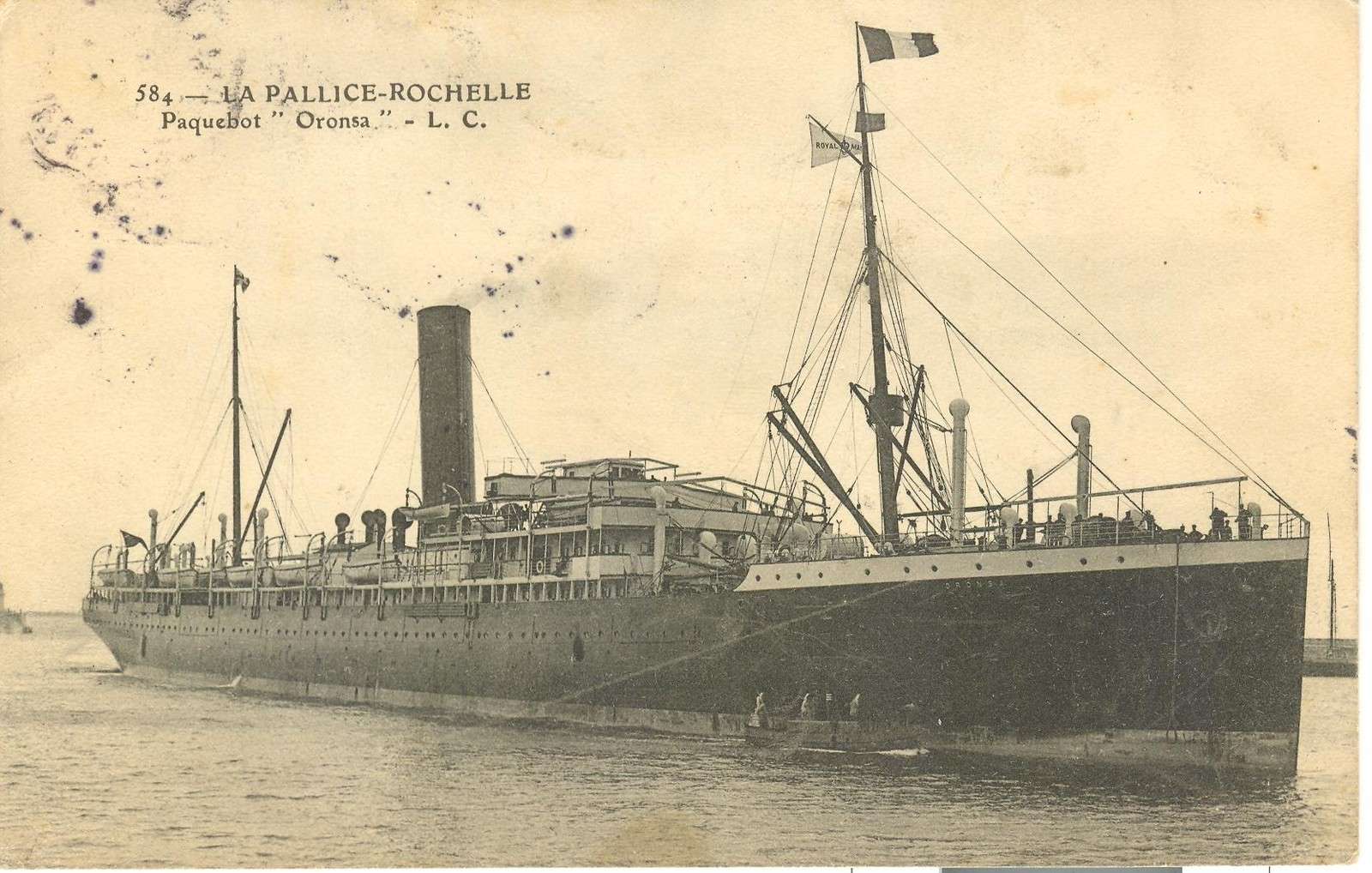
The next record I found for George was on the ship Oronsa’s crew list. His address was listed as 26 Clare Road and he had signed an agreement to board the ship on 11 July 1912 at 6am as a bandsman. His wages were £3 per month and he left the ship in Liverpool on 14 October 1912. The Oronsa was a steel hulled steam ship which had been built by Harland and Wolfe in Belfast in 1906. It was operated by the Pacific Steam Navigation Company on their Liverpool to Argentina route. During WW1 it what used as a cargo steamer; it was sunk by a U-Boat on 29 April 1918.

Oronsaship

Ship Oronsa

George re-enlisted in the army, the 2nd East Lancashire Brigade, in Manchester at the age of 50 on 16 March 1915. He was attached to the 2nd Reserve Battalion of the Royal Field Artillery as a gunner and served at “home” probably in the 190th Territorial Force Depot in Manchester. He was discharged from military service on 6 July 1917. His army pension papers include a note from 26 Clare St, Levenshulme, written on 15 February 1919, inquiring about his silver war badge which he later received.

George, Harriet and their four adult children left Levenshulme not long after WWI. George left London on 1 November 1919 and arrived in Melbourne, Australia on 12 December 1919 on the ship Orvieto; a cruise ship built in 1909 by Workman Clark, Belfast and owned by The Orient Company. The arrival of the ship was reported in a number of Australian newspapers as there were a number of returning soldiers and members of their families on it.

George and Harriet’s daughter Esme married Frank Unwin Simpson (1898-1964) on 11 December 1919. The witnesses to her marriage were her sister Marjorie and brother George. Her husband Frank left for Melbourne, Australia shortly after their wedding.

Harriet, their son George Frederick, his wife Louisa Durden (1901-1984), and daughters Gladys, Marjorie and Esme followed George and Frank to Australia. They left London for Melbourne on 17 June 1920 on the ship Beltana run by the P&O Branch Line Service and they all travelled third class.

It seems from electoral roll records that George, Harriet, their children and partners settled near Melbourne. Some of the family are buried in Box Hill Cemetery. Their son George and his wife Louisa are both buried in Drouin Cemetery in the shire of Baw Baw. Drouin is about 90 kilometres east of Melbourne.

I am interested in knowing more about what the Bean family did in Australia as I know very little about their lives there. Do contact me if you know more about them.

Note: the map used in this blog has been reproduced with the permission of the National Library of Scotland under the following creative commons licence https://creativecommons.org/licenses/by-nc-sa/4.0/ and sourced from the NLS maps site https://maps.nls.uk/.

Bibliography:

Australia Electoral Rolls, 1903-1980. https://www.ancestry.co.uk : accessed June 2020.

Australia newspapers. https://trove.nla.gov.au/ : accessed June 2020.

British Army Service Records 1760-1915. https://www.findmypast.co.uk : accessed June 2020.

British Army Service Records 1914-1920. https://www.findmypast.co.uk : accessed June 2020.

British Army WWI Medal Rolls Index Cards, 1914-1920. https://www.ancestry.co.uk : accessed June 2020.

Brockwell. https://www.calderdale.gov.uk/wtw/search/controlservlet?PageId=Detail&DocId=101852 : accessed June 2020.

Liverpool, England, crew lists, 1861-1919. https://www.ancestry.co.uk : accessed June 2020.

Oronsa. https://uboatproject.wales/wrecks/oronsa/ : accessed June 2020.

Orvieto passenger ship http://passengersinhistory.sa.gov.au/node/933273 : accessed June 2020.

OS Maps. https://maps.nls.uk/ : accessed June 2020.

Sowerby. https://www.genuki.org.uk/big/eng/YKS/WRY/Halifax/SowerbyHistory : accessed June 2020.

Territorial Force Depots. https://www.longlongtrail.co.uk/army/other-aspects-of-order-of-battle/territorial-force-depots/ : accessed June 2020.

UK, Silver War Badge Records, 1914-1920. https://www.ancestry.co.uk : accessed June 2020.

World War One British Army Pension Records 1914-1920. https://www.ancestry.co.uk : accessed June 2020.

Emily Bristow (1877-1954)

While I was researching members of the Bean family, I came across Emily the daughter of William Bristow (1838-1908) and Jane Bean (1850-1922). Emily is my first cousin three times removed. She was the daughter of a farmer and the family were living in New Grange, Airmyn, Yorkshire in the 1891 census. The village is sited where the rivers Aire and Ouse meet and is less than two miles from Goole.

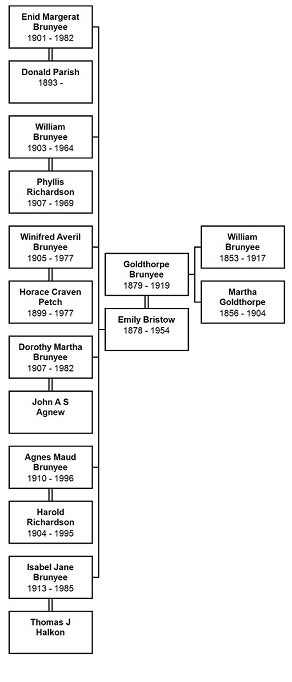
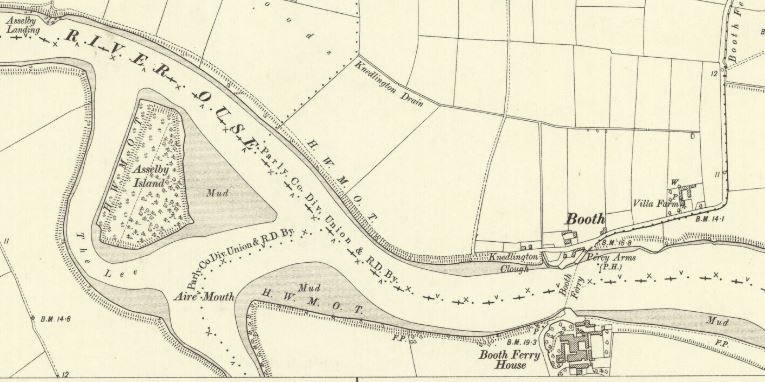
Emily married Goldthorpe Brunyee (1879-1919), the son of local landowner William Brunyee (1853-1917), in St David’s Church, Airmyn on 27 November 1900. At the time of their marriage Goldthorpe was living in Booth Ferry House and Emily at Airmyn Grange which, her parents had moved to by then. Goldthorpe was named after his mother Martha Goldthorpe (1856-1904).

OSBoothFerryHouse1907

OS Map 1907 showing Booth Ferry House

According to the recently published Oxford Dictionary of Family Names, the surname Brunyee is a nickname from the Middle English brun/brown and eye. There were 86 Brunyee’s recorded in the 1881 census; they lived mostly in the West Riding of Yorkshire and Lincolnshire. One of them wad Goldthorpe’s father William (1853-1917) who continued to live in Booth Ferry House, Airmyn near Goole until his death aged 63. William was badly burned in a fire in his house and was found by Richard Brown, a groom. The report of his inquest stated that he occupied farms at Goole Fields, Ousefleet and Howden. The jury’s verdict was that he had died of shock as a result of “burns accidentally received”. Although William died intestate the main beneficiary was his son Goldthorpe.

Returning to Emily and her husband Goldthorpe, they had at least six children as the chart at the top of this page shows. By 1911 the family were living at Goole Fields with Goldthorpe described as a farm bailiff. They had two servants and five wagoners.

OSGooleFields1907

OS Map 1907 showing Goole Fields 

Goldthorpe’s death in 1919, aged 39, was also reported in the newspapers. He was described as a prominent agriculturist living a Goole Fields and that he had died after a short illness. In 1939 his wife Emily was living at Brunthorpe, Airmyn Road, Goole with two of her daughters and their families. She was still living there when she died in 1955.

I am interested in the Brunyee family as I have limited information about them. Do contact me if you know more about them.


Note: all maps used in this blog have been reproduced with the permission of the National Library of Scotland under the following creative commons licence https://creativecommons.org/licenses/by-nc-sa/4.0/ and sourced from the NLS maps site https://maps.nls.uk/.

Bibliography:

Airmyn. https://en.wikipedia.org/wiki/Airmyn : accessed 18 June 2020.

FindmyPast. Collection: British Newspapers, 1710-1965. https://findmypast.co.uk : accessed 18 June 2020.

Hanks et al. (2016) The Oxford Dictionary of Family Names in Britain and Ireland. Oxford: Oxford University Press.

OS Maps. https://maps.nls.uk/ : accessed 19 June 2020.

University of Portsmouth, History of Airmyn, in East riding of Yorkshire and West Riding | Map and description, A Vision of Britain through Time. http://www.visionofbritain.org.uk/place/11102 : accessed 19 June 2020.

Bean family

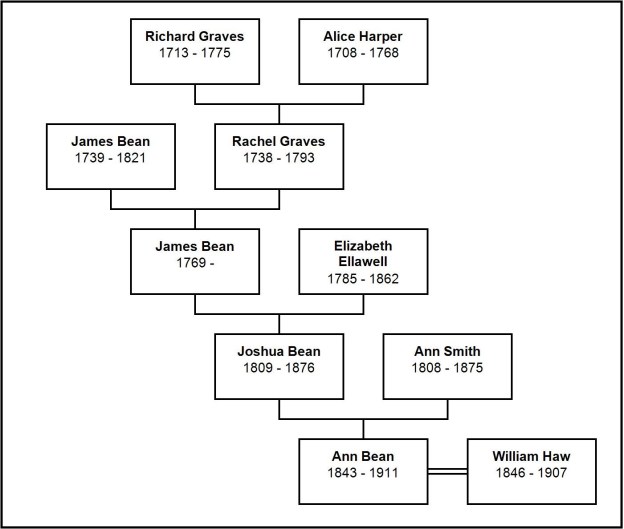
I was discussing family history with a friend a little while ago; she had decided to complete the research of her eight great grandparents. I realised that in the case of one of my own great grandmothers, Sarah Ann Haw’s (1874-1944), I knew very little about her mother Ann Bean (1843-1911). This blog post is about Ann, her parents Joshua Bean (1809-1876) and Ann Smith (1808-1875) from Claxton and her seven siblings: four brothers and three sisters.The pedigree chart shown above for Ann includes her parents Joshua and Ann, and then traces the family back three further generations who were all living in this part of the North Riding of Yorkshire.

ClaxtonmapfromVofBcircled

Parish of Bossall – see bibliography for reference

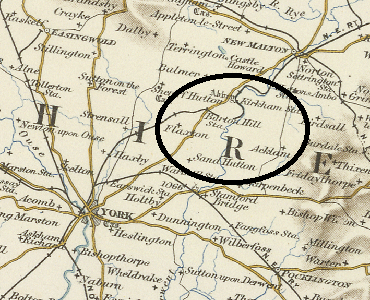
The Bean family came from Claxton in the North riding of Yorkshire. In 1870 it was described as a township within the parish of Bossall 9 miles North East North from York. Bossall is no longer a substantial village. This map from the Vision of Britain website has been annotated to show the approximate area of the parish of Bossall.


Joshua and Ann had eight children and continued to live in Claxton until their deaths. Joshua was recorded in different censuses as a gardener in 1841, farmer in 1851 and carrier in 1871. When he died his will was proved by his eldest son, John Bean (1836-1925), my third great uncle. By the time of his father’s death in 1876 John, a gamekeeper, was living in Hack Green, near Baddington, Cheshire. One of his sons, George Wetherhill Bean (1877-1915), also became a gamekeeper and died on 14 March 1915 in Hack Green. His death at the age of 37 was reported in the Nantwich Guardian. It included details of his employment; before his “protracted illness” he had been head gamekeeper to Mr Frank Barlow of Gestryn Colyn Hall, North Wales. When his father John died in 1925 there was also a report in a local paper, although this time it was in the Cheshire Observer. John was described as a “popular South Cheshire gamekeeper” and that he had been gamekeeper to Mr Bailey of Manchester who had had shooting rights on the estate of Mr Shaw of Hack Green. Hack Green is now more commonly known for its secret nuclear bunker.

BromptonCemetery

Brompton Cemetery ID 92209686 © Ken Taylor | Dreamstime.com

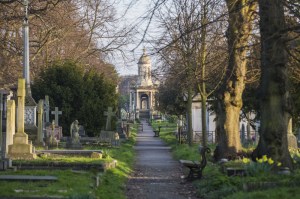
Joshua and Ann’s next three children were sons. William was born in 1837. He left Yorkshire and in 1911 was living in Blackpool, Lancashire when he was described as a Gentleman butler. He was followed by George (1839-1920) who in 1891 was described as a land steward. He had spent time outside the UK as two of his children were born in Montreal, Canada. At the time of his death he was living with one of his sons in Parsons Green, Fulham and was buried in Brompton Cemetery.


Their fourth son was James (1841-1898) who remained in Claxton. In 1891 he was described as a farmer and carrier. It is possible that he had carried on his father’s business after his death.

St._Mary's_Church,_Sand_Hutton_-_geograph.org.uk_-_1801565

St Mary’s Church, Sand Hutton

Joshua and Ann had four daughters. Their eldest daughter was my great grandmother Ann (1843-1911) who was baptised on 9 April 1843 in Bossall, Joshua’s occupation was recorded as a gardener. Ann married my two times great grandfather William Haw (1846-1907) in St Mary’s Church in the nearby village of Sand Hutton on 26 May 1870. William was a tailor from York and the marriage was witnessed by two of Ann’s brothers: John and James. After their marriage they lived in York where William continued to work as a tailor. In 1901 they were living at 45 Marygate in Bootham; it runs from Clifton to the River Ouse alongside the historic St Mary’s Abbey and the museum gardens.

Joshua and Ann had three more daughters. Sarah Elizabeth (1844-1921) married George Thornton (1845-1929) on 9 September 1875 in St Mary’s Church, Sand Hutton. At the time of their marriage George was a machinist. By 1911 he had become a school caretaker and they were living in Alexandra Street, Goole.

Their next daughter was Jane Bean (1850-1922), who also married in St Mary’s Church, Sand Hutton. Her husband was William Bristow (1838-1908) a local farmer from Claxton. They married on 7 June 1875. By 1881 William was farming Glebe Farm, Kirk Smeaton which consisted of 126 acres and employing 3 boys. The family had moved to New Grange, Airmyn by 1891. William was still a farmer and the family had moved to within six miles of Wressle which is where William had been born. When William died in 1908, he was living at Airmyn Grange near Goole; probate was granted to his wife Jane. She continued to farm at Airmyn Grange with two of her daughters, Ann (1876-1946) and Edith (1880-1943), until at least 1911. She was still living there when she died in 1922.

Joshua and Ann’s youngest daughter was Margaret (1852-1905). She also married in St Mary’s Church, Sand Hutton. Her husband was John Robinson Bowling (1846-1929), a cordwainer. They married on 18 May 1869 and their witnesses were William Haw and Margaret’s sister Ann Bean. In 1901 Margaret and John were living in Stockton on the Forest and John was described as a shoemaker.

I am interested in Joshua’s ancestors as I have limited information about them. Do contact me if you know more about the family.

Bibliography:

Bossall. https://www.genuki.org.uk/big/eng/YKS/NRY/Bossall : accessed 18 June 2020.

FindmyPast. Collection: British Newspapers, 1710-1965. https://findmypast.co.uk : accessed 18 June 2020.

Hack Green. https://en.wikipedia.org/wiki/Hack_Green_Secret_Nuclear_Bunker : accessed 18 June 2020.

Victoria county history https://www.british-history.ac.uk/vch/yorks/north/vol2/pp91-98 : accessed 17 June 2020.

University of Portsmouth, History of Claxton, in Ryedale and North Riding | Map and description, A Vision of Britain through Time. http://www.visionofbritain.org.uk/place/12069 : accessed 17 June 2020.

Ancestors in Australia

So far in my family research I have found very few people who have emigrated to Australia from either my husband or my own part of our family tree. The most notable person was Thomas King, born about 1813, who was transported to Tasmania for stealing.

Recently I discovered some distant cousins, one of whom emigrated to Australia in 1928 and the other who joined him in 1949. The first to emigrate was Frederick William Ellis (1906-1957) who was born in Luton, Bedfordshire and by 1928 living in Cople in Bedfordshire. He left England for Australia on 13 October 1928 on the ship SS Orford where his occupation was given as farming. Information on the ship he travelled on is included on the Passengers in History website.

SSOrdfordfrompassengersinhistoryFrederick seems to have settled in Western Australia and so far I’ve been unable to determine if he received assistance for his passage. He wasn’t listed as a new settler arriving on the ship SS Orford in the list published in The Western Australian newspaper dated 10 November 1928.


Frederick was living in Northam, Western Australia when he enlisted in the Australian army in WWII. After the war his sister Helena (1904-1988) and brother-in-law Ashley Herbert Lansom (born 1906), my fifth cousin once removed, together with their two sons, emigrated to Australia on the ship SS Otranto. They left Tilbury Docks, London, England on 14 October 1949 bound for Freemantle in Western Australia. On the passenger list Ashley’s occupation was listed as a plumber and they gave their intended residence as c/o Ellis, 58 Hovea Crescent, Wundowie, Western Australia. The Lansom’s seem to have settled in a suburb of Perth called Dianella as they were recorded living there in The Government Gazette dated 31 August 1979.

A resource that I’ve found really helpful to add context to these two men is the National Library of Australia’s Trove website. It is free to use and is where I found copies of The Western Australia newspaper and The Government Gazette.

Note: the photo of SS Orford came from the Passengers in History website under their Creative Commons license. It has not been modified.